

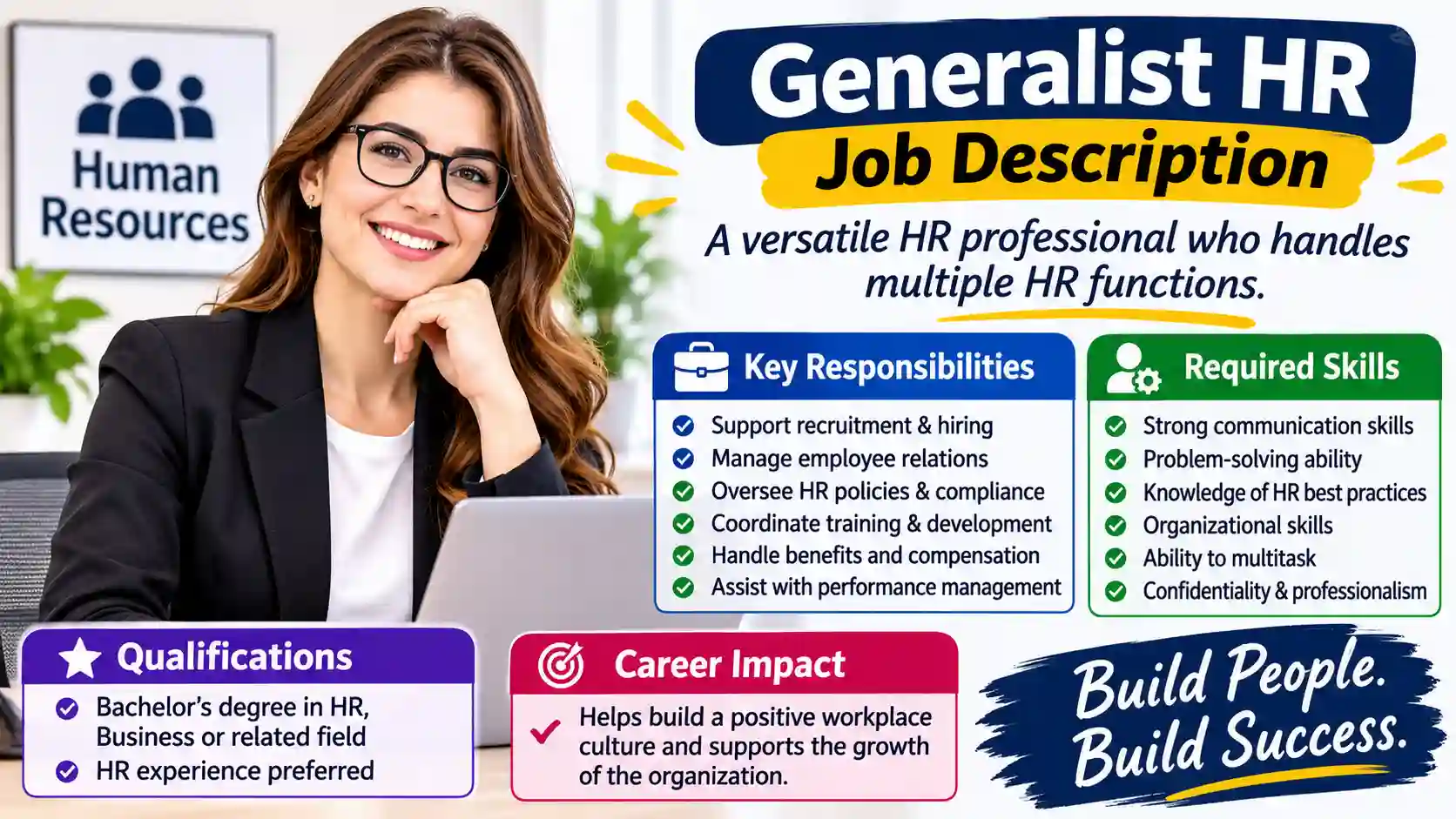
A Generalist HR professional plays an important role in managing an organization’s employees and daily human resources activities. From recruitment and onboarding to employee relations, payroll coordination, and HR compliance, an HR Generalist supports different functions within the human resources department.
Unlike an HR specialist who focuses on one particular area, an HR Generalist handles several responsibilities throughout the employee lifecycle. They work with employees, managers, and HR leaders to maintain organized workplace processes and support business goals.
This guide covers the complete generalist HR job description, including daily duties, required qualifications, essential skills, salary factors, and career opportunities. It also provides a job description template for employers and examples for resumes.
What Is an HR Generalist?
An HR Generalist is a human resources professional who manages or supports multiple HR functions within an organization. Their work includes recruitment, employee onboarding, benefits administration, employee relations, performance management, and HR documentation.
They act as a connection between employees and management. Employees may contact them about workplace policies, leave requests, payroll questions, benefits, and other employment matters.
In small businesses, an HR Generalist may handle almost every HR activity. In larger companies, they often work with specialized teams responsible for recruitment, payroll, training, and employee relations.
Generalist HR Job Description
An HR Generalist is responsible for supporting daily human resources operations and ensuring that employee-related processes are handled efficiently.

Their main responsibilities include:
- Coordinating recruitment and hiring activities.
- Preparing job descriptions and employment contracts.
- Managing employee onboarding and orientation.
- Maintaining confidential employee records.
- Supporting payroll and benefits administration.
- Helping resolve employee concerns and workplace conflicts.
- Communicating HR policies and procedures.
- Coordinating employee training and development.
- Supporting performance reviews and appraisals.
- Managing leave, attendance, and absence records.
- Assisting with employee termination and offboarding.
- Supporting employment compliance and HR reporting.
The exact duties depend on the company’s size, industry, workforce, and HR department structure.
HR Generalist Job Description Template
Employers can use the following template when advertising an HR Generalist position.
Job Title: HR Generalist
Department: Human Resources
Reports To: HR Manager or HR Director
Employment Type: Full-Time
Job Summary:
We are seeking an organized and motivated HR Generalist to support our human resources department. The successful candidate will assist with recruitment, onboarding, employee relations, payroll coordination, benefits administration, training, and HR compliance.
The HR Generalist will serve as a point of contact for employees and managers, maintain accurate personnel records, and help implement company policies and procedures.
Key Responsibilities:
- Coordinate recruitment, candidate screening, and interview scheduling.
- Prepare employment documents and offer letters.
- Manage employee onboarding and orientation.
- Maintain employee records and HRIS information.
- Support payroll and benefits administration.
- Respond to employee questions and workplace concerns.
- Coordinate performance reviews and training programs.
- Assist with leave management and attendance tracking.
- Support disciplinary procedures and employee grievances.
- Help maintain compliance with applicable employment laws.
Required Qualifications:
- Bachelor’s degree in Human Resources, Business Administration, or a related field.
- Previous experience in an HR or administrative position.
- Knowledge of recruitment and employee management.
- Strong communication and organizational skills.
- Familiarity with HR software and Microsoft Office.
Key Roles and Responsibilities of an HR Generalist

1. Recruitment and Hiring
Recruitment is one of the major responsibilities of an HR Generalist. They help organizations find qualified candidates and support the hiring process.
Their duties may include:
- Identifying staffing requirements with department managers.
- Preparing and updating job descriptions.
- Publishing job advertisements.
- Reviewing applications and resumes.
- Screening suitable candidates.
- Scheduling interviews.
- Coordinating background checks.
- Preparing offer letters and employment contracts.
- Supporting new employee hiring decisions.
In companies with dedicated recruiters, HR Generalists may focus more on hiring documentation, interview coordination, and onboarding.
2. Employee Onboarding
Employee onboarding helps new hires understand their job responsibilities, workplace policies, and company expectations.
An HR Generalist may:
- Prepare new-hire documentation.
- Collect employee information.
- Coordinate orientation sessions.
- Explain company policies and benefits.
- Introduce employees to relevant departments.
- Arrange required system access.
- Maintain onboarding checklists.
- Coordinate employment eligibility verification where required.
For example, US employers may need to complete Form I-9 to verify employment eligibility. Other countries have their own employment documentation requirements.
3. Employee Relations
Employee relations focuses on building positive relationships between employees and management.
An HR Generalist helps maintain a professional work environment by:
- Answering employee questions.
- Listening to workplace concerns.
- Supporting conflict resolution.
- Documenting employee complaints.
- Assisting with grievance procedures.
- Supporting managers during disciplinary matters.
- Explaining workplace policies.
- Maintaining confidentiality.
They may also help managers communicate difficult decisions and follow consistent employee management procedures.
4. Payroll and Benefits Administration
HR Generalists may coordinate payroll and employee benefits activities. Their exact responsibilities depend on whether the company has a separate payroll department.
Common duties include:
- Reviewing attendance and working hours.
- Updating salary and compensation records.
- Coordinating payroll information with finance.
- Answering employee questions about pay.
- Supporting health insurance administration.
- Maintaining benefits records.
- Helping employees understand retirement plans.
- Coordinating bonuses and other compensation changes.
For example, some US organizations offer 401(k) retirement savings plans. An HR Generalist may help employees understand enrollment procedures and direct detailed questions to the benefits provider.
5. HR Policies and Compliance
HR Generalists help organizations maintain clear workplace policies and follow applicable employment requirements.
Their responsibilities include:
- Reviewing and communicating HR policies.
- Updating the employee handbook.
- Maintaining employment contracts.
- Supporting employment compliance activities.
- Keeping required employee documentation.
- Monitoring attendance and leave procedures.
- Helping managers understand workplace rules.
- Supporting internal HR reviews.
In the United States, relevant employment requirements may include the Family and Medical Leave Act (FMLA), employment eligibility verification, and applicable federal and state regulations. HR professionals must follow the laws that apply to their organization.
6. Employee Training and Development
Training helps employees improve their skills and perform their jobs effectively.
An HR Generalist may:
- Identify employee training needs.
- Organize training sessions.
- Coordinate orientation programs.
- Maintain training records.
- Support professional development plans.
- Collect feedback from employees.
- Help managers identify skill gaps.
- Coordinate leadership development activities.
These activities support employee growth and organizational development.
7. Performance Management
Performance management helps employees understand their responsibilities and work toward clear goals.
An HR Generalist may:
- Coordinate performance review schedules.
- Prepare appraisal forms.
- Help managers document employee performance.
- Track completed performance reviews.
- Support employee development plans.
- Assist with performance improvement plans.
- Maintain performance records.
They may also help organizations review performance management processes and identify opportunities to improve employee productivity.
8. Maintaining Employee Records
Accurate employee records are essential for effective HR administration.
An HR Generalist may maintain:
- Employee personal information.
- Employment contracts and offer letters.
- Job descriptions.
- Organizational charts.
- Attendance and leave records.
- Training records.
- Performance appraisals.
- Compensation and benefits information.
- Disciplinary documentation.
- Employment verification records.
These documents should be stored securely, and access should be limited to authorized personnel.
HR Generalist Duties in Small and Large Companies
The responsibilities of an HR Generalist can vary depending on the organization’s size and workforce.

In small companies:
- Managing recruitment and onboarding.
- Supporting payroll and benefits administration.
- Maintaining employee files.
- Answering employee questions.
- Preparing workplace policies.
- Handling general HR administration.
In large companies:
- Working with specialized HR teams.
- Coordinating HR activities across departments.
- Supporting managers with employee relations.
- Maintaining HRIS information.
- Preparing workforce reports.
- Helping implement organization-wide HR policies.
Small organizations often require broader responsibilities, while larger organizations may divide duties among different HR professionals.
HR Generalist Daily Tasks and Work Schedule
An HR Generalist’s daily schedule depends on hiring requirements, employee requests, and company priorities.
| Time | Typical Responsibilities |
| Morning | Review emails, attendance, and employee requests |
| Mid-Morning | Coordinate interviews and onboarding |
| Afternoon | Handle employee relations and HR documentation |
| Late Afternoon | Update HRIS records and prepare reports |
| End of Day | Review pending tasks and plan priorities |
Other daily activities may include preparing employment letters, updating employee files, reviewing job descriptions, and communicating with department managers.
HR Generalist Software and Tools
Technology helps HR Generalists manage employee information, recruitment, payroll coordination, and administrative work.
Common tools include:
Human Resource Information System (HRIS)
An HRIS stores employee information, job details, attendance, compensation records, and other HR data. It helps professionals organize employee information and prepare reports.
Applicant Tracking System (ATS)
An ATS helps manage job applications, candidate screening, interview scheduling, and recruitment activities.
Payroll Management Software
Payroll software supports salary calculations, payment records, deductions, and payroll reporting.
Microsoft Excel
Excel is useful for organizing employee information, preparing reports, tracking attendance, and analyzing HR data.
Time and Attendance Systems
These systems help record working hours, employee attendance, overtime, and leave.
Employee Management Systems
Employee management platforms support employee information, performance records, and routine HR processes.
HR Generalist KPIs and Performance Metrics
Key performance indicators help organizations measure the effectiveness of HR processes.

| KPI | What It Measures |
| Time to Hire | Time needed to fill an open position |
| Employee Turnover Rate | Percentage of employees leaving |
| Employee Retention Rate | Percentage of employees staying |
| Onboarding Completion Rate | Percentage of new hires completing onboarding |
| Training Completion Rate | Percentage of employees completing training |
| Absenteeism Rate | Frequency of employee absences |
| HR Request Resolution Time | Time taken to resolve employee requests |
HR Generalists may prepare reports using HRIS data and other records to help managers identify workforce trends.
HR Generalist Termination and Offboarding Responsibilities
Offboarding is the process of managing an employee’s departure from an organization.
An HR Generalist may:
- Prepare termination documentation.
- Coordinate employee separation procedures.
- Arrange exit interviews.
- Update employee records.
- Coordinate the return of company property.
- Inform relevant departments about the departure.
- Communicate final payroll information to the payroll team.
- Support managers during the offboarding process.
Exit interviews can help organizations understand employee concerns and identify possible improvements in workplace practices and employee retention.
HR Generalist Leave and Absence Management
HR Generalists help manage employee leave requests and maintain accurate absence records.
Their duties may include:
- Reviewing vacation and sick leave requests.
- Updating leave balances.
- Recording employee absences.
- Explaining company leave policies.
- Maintaining leave documentation.
- Coordinating approved leave information with payroll.
- Supporting family and medical leave administration where applicable.
In the United States, this may include FMLA-related processes for eligible employees. Leave laws and entitlements differ across countries and regions.
Workplace Safety and Workers’ Compensation
Workplace safety is another area in which HR Generalists may provide administrative support.
Their responsibilities may include:
- Maintaining workplace incident records.
- Coordinating safety training.
- Communicating safety policies.
- Helping employees report workplace injuries.
- Supporting workers’ compensation documentation.
- Coordinating with managers and safety teams.
- Following up on reported incidents.
For example, if an employee is injured at work, the HR Generalist may help document the incident and coordinate the required information with the relevant department or insurance provider.
HR Generalist Qualifications and Education
Most employers prefer candidates with relevant education and practical experience in human resources.

Common qualifications include:
- Bachelor’s degree in Human Resources.
- Degree in Business Administration or Management.
- Diploma or certification in HR management.
- Previous experience in an HR or administrative position.
- Knowledge of recruitment and onboarding.
- Understanding of employee relations.
- Familiarity with employment policies and documentation.
- Experience with HRIS or other HR software.
Some organizations accept relevant professional experience or equivalent qualifications instead of a specific degree.
Essential Skills Required for an HR Generalist
An effective HR Generalist needs a combination of administrative, communication, and interpersonal skills.
Communication Skills: The ability to communicate clearly with employees, candidates, managers, and HR leaders.
Organizational Skills: The ability to manage employee records, schedules, deadlines, and multiple tasks.
Problem-Solving Skills: The ability to understand workplace issues and help identify practical solutions.
Confidentiality: The ability to protect sensitive employee information and handle private matters responsibly.
Attention to Detail: Accuracy when preparing contracts, updating employee information, and coordinating payroll.
Technology Skills: Familiarity with HRIS platforms, ATS tools, spreadsheets, and office software.
Interpersonal Skills: The ability to build professional relationships and work with different teams.
Time Management: The ability to prioritize important HR activities and meet deadlines.
HR Generalist Job Description for Resume
An HR Generalist resume should highlight relevant experience, responsibilities, and professional skills.
Example Resume Summary:
Organized and detail-oriented HR Generalist with experience supporting recruitment, employee onboarding, employee relations, payroll coordination, benefits administration, and HR documentation. Skilled in maintaining confidential employee records, using HRIS platforms, coordinating performance reviews, and supporting HR policies and procedures.
Example Resume Responsibilities:
- Coordinated recruitment, candidate screening, and interview scheduling.
- Managed employee onboarding and orientation activities.
- Maintained confidential employee records and HRIS information.
- Supported payroll and benefits administration.
- Assisted with employee relations and workplace concerns.
- Coordinated performance reviews and training programs.
- Supported employment compliance and HR policy implementation.
- Prepared employee reports and maintained HR documentation.
Candidates should include only duties and skills that reflect their actual experience.
Entry-Level HR Generalist Job Description
An entry-level HR Generalist usually supports experienced HR professionals with routine administrative and employee-related tasks.

Typical responsibilities include:
- Updating employee information.
- Organizing personnel files.
- Scheduling interviews.
- Preparing onboarding documents.
- Answering basic employee questions.
- Supporting training arrangements.
- Tracking attendance and leave records.
- Assisting with HR reports.
- Maintaining recruitment documentation.
This position provides practical experience in different HR functions and can help candidates develop the skills needed for more advanced roles.
Senior HR Generalist Job Description
A Senior HR Generalist handles more complex responsibilities and may provide guidance to managers and junior HR professionals.
Typical duties include:
- Managing complex employee relations matters.
- Advising managers on HR policies.
- Supporting workforce planning.
- Coordinating compensation reviews.
- Improving HR processes and systems.
- Reviewing workforce reports.
- Supporting organizational development.
- Leading HR projects.
- Helping implement HR strategies.
A senior professional may also help improve employee retention, organizational performance, and HR service delivery.
HR Generalist vs. HR Specialist
Although both positions work in human resources, their responsibilities are different.
| HR Generalist | HR Specialist |
| Handles multiple HR functions | Focuses on one HR area |
| Supports recruitment, onboarding, and employee relations | May specialize in recruitment, payroll, or benefits |
| Works across different HR activities | Develops deeper knowledge in a specific function |
| Supports general HR operations | Manages specialized HR processes |
An HR Generalist usually has broader responsibilities, while an HR Specialist develops deeper expertise in a particular HR function.
HR Generalist Career Path
An HR Generalist can progress into several human resources positions as they gain experience and improve their professional skills.
A possible career path includes:
- HR Assistant
- HR Coordinator
- HR Generalist
- Senior HR Generalist
- HR Manager
- HR Director
Some professionals may also move into employee relations, talent acquisition, compensation and benefits, HR business partner, or organizational development roles.
Common HR Generalist Interview Questions
Candidates preparing for an HR Generalist position should understand the role and be ready to discuss practical workplace situations.
Common interview questions include:
- What are the main responsibilities of an HR Generalist?
- How do you manage multiple HR tasks?
- How would you handle a workplace conflict?
- What steps would you follow when onboarding a new employee?
- How do you maintain confidential employee records?
- Which HRIS or ATS platforms have you used?
- How would you support a manager during a performance issue?
- What experience do you have with payroll and benefits?
- How do you stay informed about employment policies?
- How would you handle an employee grievance?
Candidates should prepare examples from their own experience and explain how they approach common HR situations.
HR Generalist Work Environment
HR Generalists typically work in office environments, although some organizations offer hybrid or remote arrangements.
They communicate regularly with employees, managers, recruiters, payroll teams, and senior HR professionals. Their work may involve meetings, recruitment coordination, employee documentation, HR reporting, and confidential employee matters.
Workloads can change throughout the year because of hiring needs, performance reviews, policy updates, and employee concerns.
HR Generalist Salary

An HR Generalist’s salary depends on several factors, including:
- Geographic location.
- Years of HR experience.
- Education and professional qualifications.
- Company size.
- Industry.
- Technical and HR software skills.
- Level of responsibility.
Entry-level HR Generalists generally earn less than experienced and senior professionals. Additional expertise in employee relations, compensation, HR technology, and compliance may help improve career opportunities.
For accurate salary expectations, candidates should current job listings and salary reports for their country and experience level.
HR Generalist Job Description Summary
An HR Generalist supports the daily operations of a human resources department by managing or coordinating recruitment, onboarding, employee relations, payroll, benefits, training, performance management, and employee documentation.
The position requires strong communication, organization, confidentiality, problem-solving, and technology skills. HR Generalists help employees and managers while ensuring that workplace processes remain organized and consistent.
Frequently Asked Questions
An HR Generalist supports different human resources functions, including recruitment, onboarding, employee relations, payroll coordination, benefits administration, training, and employee records.
The main responsibilities include hiring support, employee onboarding, HR administration, employee relations, performance management, benefits coordination, and employment compliance.
Many employers prefer a bachelor’s degree in Human Resources, Business Administration, or a related field. Relevant HR experience and knowledge of employment practices are also valuable.
Important skills include communication, organization, problem-solving, confidentiality, attention to detail, interpersonal skills, time management, and knowledge of HR software.
No. An HR Generalist handles several HR functions, while an HR Specialist focuses on a particular area such as recruitment, payroll, benefits, or employee relations.
An HR Generalist usually supports everyday HR operations, while a Senior HR Generalist handles complex responsibilities, advises managers, and may lead HR projects.
It depends on the organization. Some HR Generalists coordinate payroll information and answer employee questions, while others work with a dedicated payroll department.
Common tools include HRIS platforms, Applicant Tracking Systems, payroll software, Microsoft Excel, and time and attendance systems.
Yes. Candidates can begin with an HR assistant or coordinator position, gain practical experience, and develop the skills needed to become an HR Generalist.
Final Thoughts
An HR Generalist plays an important role in managing employee-related activities and supporting the daily operations of an organization. The position combines recruitment, onboarding, employee relations, payroll coordination, HR administration, training, and compliance.

Ryan Mitchell writes job descriptions, role overviews and general description guides in plain, easy-to-follow language. He focuses on listing duties, skills and requirements clearly, so readers can understand a role or topic without wading through jargon.