

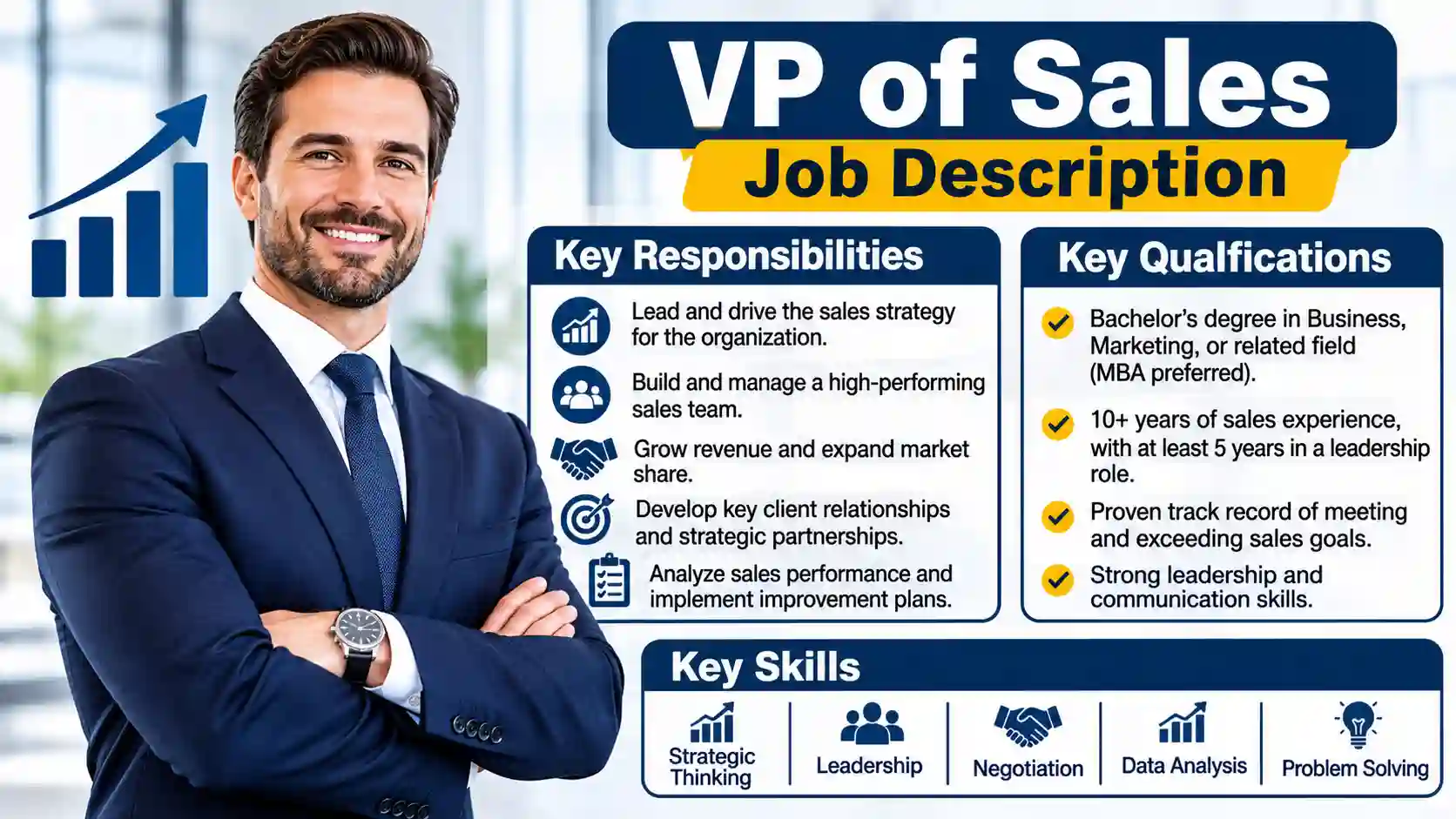
A Vice President of Sales (VP of Sales) is a senior business leader responsible for managing a company’s sales department, developing sales strategies, leading sales teams, and increasing revenue. This professional helps a business reach its sales goals by building strong customer relationships, improving sales processes, and identifying new market opportunities.
A VP of Sales job description explains the main duties, responsibilities, qualifications, and skills required for this leadership position. The role may differ depending on the company’s size, industry, business model, and sales goals. In a small business, a VP of Sales may handle daily sales activities, while in a large organization, the position usually focuses on long-term strategy and department performance.
This guide explains what a VP of Sales does, the skills and experience required, salary expectations, career opportunities, and a ready-to-use job description template.
What Is a VP of Sales?
VP of Sales means Vice President of Sales. It is an executive-level position responsible for leading a company’s sales department and creating plans to increase revenue.
A VP of Sales works with sales managers, account executives, sales development representatives (SDRs), and business development representatives (BDRs) to improve team performance. They also work with other departments, including marketing, finance, product, and customer success.
The main goal of this position is to build an effective sales organization that can attract customers, close deals, maintain relationships, and achieve predictable revenue growth.
In many B2B companies, the VP of Sales also manages the complete sales process, from lead generation and prospecting to pipeline management and closing deals.
VP of Sales Job Description

A VP of Sales develops and manages sales strategies to help a company reach its revenue targets. This person leads the sales department, manages employees, monitors performance, and identifies opportunities for business growth.
The VP of Sales also works with senior executives to create sales budgets, set realistic targets, review market trends, and improve the company’s competitive position.
Job Title: Vice President of Sales
Department: Sales
Reports To: Chief Executive Officer (CEO), President, or Chief Revenue Officer (CRO)
Job Type: Full-Time, Executive-Level Position
Job Summary:
We are looking for an experienced and results-driven Vice President of Sales to lead our sales department and support business growth. The successful candidate will develop sales strategies, manage sales teams, establish revenue goals, and build strong relationships with customers and business partners.
The ideal candidate should have excellent leadership, communication, negotiation, and strategic planning skills. They should also understand sales operations, market research, sales forecasting, and customer relationship management.
Key Responsibilities of a VP of Sales
A VP of Sales has several responsibilities related to business growth, team management, revenue generation, and sales operations. The exact duties depend on the organization, but the following are common VP of Sales job responsibilities.
1. Develop Sales Strategies
One of the main responsibilities is creating sales strategies that support the company’s business goals. The VP of Sales studies market conditions, customer needs, and competitor activities before developing a sales plan.
They identify target customers, select suitable sales channels, and create plans to increase revenue and market share.
2. Lead and Manage the Sales Team
A VP of Sales leads sales managers, account executives, SDRs, and BDRs. They assign responsibilities, establish performance expectations, and make sure employees understand their targets.
They also hire qualified employees, provide training, offer guidance, and motivate team members to achieve better results.
3. Set Sales Goals and Quotas
The VP of Sales establishes sales goals and quotas for individuals, teams, and departments. These targets help employees understand what they need to achieve within a specific period.
They review historical performance, market demand, available resources, and business objectives to set realistic targets.
4. Manage Sales Operations
Sales operations involve the processes, systems, and tools used to support the sales department. A VP of Sales works with sales operations and revenue operations (RevOps) teams to improve efficiency.
Their responsibilities may include improving sales workflows, managing sales technology, reviewing CRM data, and making sure the team follows consistent sales procedures.
5. Monitor Sales Performance
A VP of Sales regularly reviews sales reports and performance metrics to understand whether the department is meeting its goals.
They identify problems in the sales process, review employee performance, and introduce improvements when necessary.
6. Build Customer Relationships
Maintaining strong customer relationships is important for long-term business success. The VP of Sales may communicate with major clients, enterprise customers, business partners, and important stakeholders.
They help resolve serious customer concerns, support important negotiations, and identify opportunities to increase customer retention.
7. Prepare Sales Budgets and Forecasts
The VP of Sales works with finance and senior management to prepare sales budgets and revenue forecasts.
They estimate future sales, review expected expenses, and monitor the financial performance of the department. Accurate forecasting helps businesses make better decisions about hiring, marketing, and future investments.
8. Research Markets and Competitors
Understanding the market helps a company remain competitive. The VP of Sales studies customer behavior, industry trends, competitor pricing, and new business opportunities.
They use this information to improve sales strategies, identify new customer segments, and adjust business plans.
9. Work With Other Departments
A VP of Sales collaborates with several departments to support company-wide objectives.
Common working relationships include:
- Marketing: Aligning lead generation, campaigns, messaging, and customer targeting.
- Finance: Managing budgets, sales forecasts, pricing, and compensation plans.
- Product: Sharing customer feedback and identifying product improvement opportunities.
- Customer Success: Supporting customer retention, renewals, and account growth.
- Human Resources: Recruiting, training, and retaining sales employees.
- Legal: Reviewing contracts and helping ensure sales agreements follow company policies.
10. Improve Sales Processes
The VP of Sales reviews existing sales processes to identify delays, communication problems, and missed opportunities.
They may introduce sales playbooks, improve prospecting methods, update sales scripts, and use automation to help employees work more efficiently.
What Does a VP of Sales Do Every Day?
The daily work of a VP of Sales includes managing employees, reviewing performance, meeting with executives, and making important sales decisions.

A typical day may include:
- Reviewing sales reports and revenue performance.
- Checking the sales pipeline and upcoming opportunities.
- Meeting with sales managers and department leaders.
- Discussing important deals with account executives.
- Reviewing sales forecasts and quarterly targets.
- Coaching employees and solving team challenges.
- Meeting with major customers or business partners.
- Coordinating with marketing and product teams.
- Reviewing competitor activities and market changes.
- Planning improvements to sales strategies.
The daily schedule may change depending on the company’s size and business needs. Some VPs spend more time with customers, while others focus on strategy, forecasting, and team leadership.
Essential Skills for a VP of Sales
A successful VP of Sales needs a combination of leadership, business, communication, and analytical skills. These abilities help them manage employees and make decisions that support revenue growth.
Leadership Skills
Leadership skills help a VP of Sales guide employees, manage sales managers, and create a productive team environment. They should be able to set clear expectations, solve problems, and motivate employees.
Communication Skills
Strong communication is necessary for working with customers, employees, executives, and business partners. A VP of Sales must explain strategies clearly and share important performance information.
Strategic Planning
Strategic planning helps the VP of Sales create long-term plans, understand market opportunities, and establish realistic business goals.
Negotiation Skills
Negotiation skills are important when discussing prices, contracts, partnerships, and major customer agreements. A strong negotiator can protect business interests while maintaining positive relationships.
Analytical Skills
A VP of Sales should understand sales data, revenue reports, conversion rates, and forecasting results. Analytical skills help identify performance problems and make informed decisions.
Decision-Making Skills
Sales leaders often make important decisions about hiring, budgets, sales territories, pricing, and team structure. Good decision-making helps businesses respond to challenges and opportunities.
Customer Relationship Management
Knowledge of customer relationship management (CRM) helps a VP of Sales track customer interactions, manage sales opportunities, and improve communication across the team.
Important KPIs for a VP of Sales
Key performance indicators (KPIs) help measure the effectiveness of a sales department. A VP of Sales uses these measurements to understand team performance and identify areas that need improvement.
Common VP of Sales KPIs include:
- Revenue Growth: Measures how much company revenue increases over a specific period.
- Quota Attainment: Shows how successfully sales representatives achieve their assigned targets.
- Win Rate: Measures the percentage of qualified sales opportunities that become customers.
- Sales Pipeline Coverage: Compares the value of open opportunities with future sales targets.
- Sales Cycle Length: Measures the average time required to close a deal.
- Customer Acquisition Cost (CAC): Estimates the cost of acquiring a new customer.
- Customer Retention Rate: Measures how well the company keeps existing customers.
- Forecast Accuracy: Compares predicted sales with actual sales results.
The VP of Sales should review these KPIs regularly instead of waiting until the end of a quarter. This allows the team to identify problems early and make timely improvements.
Qualifications and Education for a VP of Sales
Most companies prefer candidates with a strong educational background and several years of sales leadership experience.
Common qualifications include:
- A bachelor’s degree in business administration, marketing, sales, finance, or a related field.
- A master’s degree in business administration (MBA) may be preferred for senior executive positions.
- Several years of experience in sales management or business development.
- Experience managing sales teams and meeting revenue targets.
- Knowledge of sales strategies, market research, and forecasting.
- Experience using CRM software and sales reporting tools.
- Strong communication, leadership, and negotiation abilities.
Some organizations may accept equivalent professional experience instead of a specific degree. Requirements often depend on the industry and company size.
How Much Does a VP of Sales Earn?
VP of Sales salary depends on several factors, including location, industry, company size, experience, and performance.
A compensation package may include:
- Base salary.
- Annual performance bonuses.
- Sales commissions or incentive payments.
- Stock options or equity in some companies.
- Retirement benefits.
- Health insurance and other employee benefits.
Technology, software, SaaS, manufacturing, and enterprise sales organizations may offer different compensation structures. Candidates should review the complete package instead of comparing base salaries alone.
For accurate salary expectations, compare current job postings and salary reports for the relevant location and industry.
VP of Sales Job Description in a Startup
A VP of Sales job description in a startup may include more hands-on responsibilities than the same position in a large company.

Startups often have smaller teams, limited budgets, and changing business needs. As a result, the VP of Sales may develop the sales strategy while also participating in prospecting, customer meetings, and important negotiations.
Common responsibilities in a startup include:
- Building the first sales team.
- Identifying the ideal customer profile (ICP).
- Creating the sales process and sales playbooks.
- Developing lead generation and prospecting strategies.
- Managing early customer relationships.
- Establishing sales targets and revenue forecasts.
- Selecting CRM software and sales tools.
- Testing different sales channels.
- Working closely with founders and marketing teams.
In a growing startup, the VP of Sales helps create a repeatable sales process that can support future business expansion.
Senior VP of Sales Job Description
A Senior Vice President of Sales (Senior VP of Sales or SVP of Sales) usually has broader leadership responsibilities than a standard VP of Sales.
The exact difference depends on the company’s organizational structure. In some businesses, an SVP manages multiple sales departments, regions, or business units.
Typical responsibilities may include:
- Leading large or multiple sales organizations.
- Developing company-wide sales strategies.
- Managing regional or divisional sales leaders.
- Working with the CEO and executive leadership team.
- Supporting major partnerships and enterprise accounts.
- Reviewing long-term revenue performance.
- Managing large sales budgets and organizational changes.
A Senior VP of Sales generally focuses on broader business priorities, while a VP of Sales may concentrate more directly on the performance of a particular sales department.
Director of Sales vs. VP of Sales
A Director of Sales and a VP of Sales both help businesses increase revenue, but their responsibilities and authority are often different.
A Director of Sales usually manages a specific sales team, region, or department. A VP of Sales generally has wider responsibility for the overall sales strategy and department performance.
Director of Sales responsibilities may include:
- Managing sales representatives.
- Monitoring daily sales activities.
- Supporting customer negotiations.
- Reviewing team targets.
- Reporting results to senior leadership.
VP of Sales responsibilities may include:
- Creating the overall sales strategy.
- Managing sales directors and managers.
- Establishing department-wide revenue goals.
- Preparing sales budgets and forecasts.
- Working with the CEO and other executives.
- Leading long-term sales growth plans.
In smaller companies, the two titles may sometimes describe similar responsibilities. In larger organizations, the VP of Sales is usually a more senior position.
VP of Sales vs. Chief Revenue Officer (CRO)
A VP of Sales and a Chief Revenue Officer (CRO) both contribute to business growth, but they usually have different areas of responsibility.
A VP of Sales mainly focuses on sales strategy, sales teams, pipeline management, and closing revenue opportunities.
A CRO generally oversees a broader revenue function. Depending on the company, this may include sales, marketing, customer success, renewals, and other revenue-related activities.
When both positions exist, the VP of Sales may report directly to the CRO.
VP of Sales and Marketing Job Description
A VP of Sales and Marketing manages both sales and marketing activities within an organization. This combined position focuses on attracting potential customers, increasing brand awareness, generating leads, and converting opportunities into revenue.
Common responsibilities include:
- Developing sales and marketing strategies.
- Managing sales and marketing employees.
- Planning promotional campaigns.
- Improving lead generation activities.
- Building customer and business relationships.
- Reviewing market trends and competitor activities.
- Monitoring sales and marketing performance.
- Coordinating campaigns with overall business goals.
This combined position is more common in organizations where sales and marketing departments work closely under one executive leader.
VP of Sales Operations Job Description
A VP of Sales Operations focuses on improving the systems, processes, and resources that support the sales department.
This role may oversee sales planning, reporting, CRM management, territory assignments, sales technology, and performance analysis.
Typical responsibilities include:
- Improving sales processes and workflows.
- Managing sales reporting and analytics.
- Supporting sales forecasting.
- Reviewing sales territories and quotas.
- Managing CRM systems and sales technology.
- Coordinating with finance and revenue operations.
- Identifying opportunities to improve sales productivity.
The VP of Sales Operations often works closely with the VP of Sales to make the sales organization more efficient.
First 90 Days as a VP of Sales
The first 90 days are important for understanding the business, evaluating the sales team, and creating a practical improvement plan.
A new VP of Sales can divide this period into three stages.
First 30 Days: Understand the Business
During the first month, the VP should learn about the company’s products, customers, sales processes, and business goals.
Important activities include meeting team members, reviewing sales reports, studying customer feedback, and understanding the existing sales pipeline.
Days 31–60: Identify Problems and Opportunities
During the second month, the VP should review team performance, sales processes, market segments, and forecasting methods.
They can identify problems such as weak lead quality, unclear sales targets, poor follow-up, or inefficient workflows.
Days 61–90: Create and Implement Improvements
During the final month, the VP should introduce practical improvements based on the information collected.
These may include updated sales targets, improved coaching plans, clearer sales processes, better reporting, and a stronger revenue strategy.
The first 90 days should focus on understanding the business before making major changes.
VP of Sales Career Path
Many professionals become VPs of Sales after gaining experience in sales, account management, business development, and team leadership.
A common career path may look like this:
- Sales Representative
- Account Executive
- Senior Account Executive
- Sales Manager
- Director of Sales
- Vice President of Sales
- Senior Vice President of Sales
- Chief Revenue Officer
This career path is not the same for every professional. Some people move into executive positions through business development, regional sales leadership, or sales operations.
To become a VP of Sales, professionals generally need a strong record of achieving sales targets, managing teams, developing strategies, and delivering business results.
Common Challenges Faced by a VP of Sales
A VP of Sales must handle several challenges while managing the sales department and supporting company growth.
Common challenges include:
- Missing Sales Targets: Market changes, weak lead quality, or unrealistic quotas can affect sales performance.
- Hiring the Right Employees: Finding skilled sales professionals and retaining top performers can be difficult.
- Unpredictable Revenue: Poor pipeline management and inaccurate forecasts can make business planning harder.
- Strong Competition: Competitor pricing, products, and marketing strategies can affect customer decisions.
- Low Team Motivation: Sales pressure and missed targets may reduce employee confidence.
- Inefficient Sales Processes: Unclear workflows and outdated tools can reduce productivity.
A successful VP of Sales addresses these problems through planning, coaching, performance analysis, and continuous process improvement.
Executive Assistant to VP of Sales Job Description
An Executive Assistant to the VP of Sales supports the executive with administrative and organizational tasks. This position is different from the VP of Sales role because it focuses on helping the executive manage daily activities rather than leading the sales department.
Common responsibilities include:
- Managing the VP’s calendar and appointments.
- Scheduling meetings with employees and clients.
- Preparing reports and presentations.
- Organizing business travel.
- Managing emails and important documents.
- Coordinating communication between departments.
- Following up on assigned tasks and meeting deadlines.
An executive assistant helps the VP of Sales stay organized and focus on important business decisions.
VP of Sales Job Description: SHRM and Hiring Considerations
Employers creating a VP of Sales job description may use professional HR guidance, including resources from the Society for Human Resource Management (SHRM), to support clear and consistent hiring practices.

A useful job description should explain the position’s purpose, reporting structure, essential responsibilities, qualifications, experience requirements, and expected skills.
Before publishing the job posting, employers should:
- Use a clear and accurate job title.
- Explain the main duties of the position.
- Separate required qualifications from preferred qualifications.
- Describe the reporting structure.
- Include relevant experience and education requirements.
- Use fair and job-related hiring criteria.
- Review the description for clarity and applicable employment requirements.
A company should tailor its job description to its actual needs rather than copying a generic template without reviewing it.
Ready-to-Use VP of Sales Job Description Template
Job Title: Vice President of Sales
Department: Sales
Reports To: CEO or Chief Revenue Officer
Job Type: Full-Time
Job Summary:
We are seeking an experienced Vice President of Sales to lead our sales department and develop strategies that support business growth. The ideal candidate will have a proven background in sales leadership, team management, revenue generation, and strategic planning.
Responsibilities:
- Develop and implement effective sales strategies.
- Lead, manage, and motivate the sales team.
- Establish sales goals, quotas, and performance standards.
- Monitor revenue growth and sales performance.
- Prepare sales budgets, forecasts, and reports.
- Build and maintain relationships with key customers.
- Research market trends and competitor activities.
- Improve sales processes and team productivity.
- Collaborate with marketing, finance, product, and customer success teams.
- Identify new business opportunities and support company growth.
Qualifications:
- Bachelor’s degree in business, marketing, or a related field.
- MBA or master’s degree preferred.
- Several years of sales management experience.
- Proven record of achieving revenue targets.
- Strong leadership and communication skills.
- Knowledge of CRM systems and sales analytics.
- Excellent negotiation and decision-making abilities.
Benefits:
Compensation and benefits may include a competitive salary, performance bonuses, health insurance, retirement plans, and other company-specific benefits.
Frequently Asked Questions
A VP of Sales leads the sales department, develops sales strategies, manages employees, sets revenue goals, and monitors performance. The main objective is to help the company increase sales and achieve its business targets.
VP of Sales stands for Vice President of Sales. It is a senior executive position responsible for managing sales activities and supporting company revenue growth.
The main duties include managing sales teams, creating sales strategies, setting quotas, preparing forecasts, managing budgets, building customer relationships, and improving sales performance.
Most employers prefer a bachelor’s degree in business, marketing, or a related field, along with several years of sales management experience. Strong leadership, communication, and strategic planning skills are also important.
A VP of Sales salary varies by location, industry, company size, experience, and compensation structure. The total package may include base pay, bonuses, commissions, and equity.
In many organizations, yes. A VP of Sales usually has broader responsibility for the overall sales department, while a Director of Sales often manages a specific team, region, or function.
A VP of Sales mainly leads the sales function. A Chief Revenue Officer usually oversees a wider revenue organization that may include sales, marketing, customer success, and renewals.
Yes. A VP of Sales in a startup may build the sales team, create sales processes, identify target customers, manage early deals, and develop a strategy for sustainable growth.
Common KPIs include revenue growth, quota attainment, win rate, pipeline coverage, sales cycle length, customer acquisition cost, customer retention, and forecast accuracy.
Final Thoughts
A VP of Sales plays an important role in a company’s growth and long-term success. This executive develops sales strategies, manages employees, monitors performance, builds customer relationships, and makes decisions that support revenue generation.
A strong VP of Sales job description should clearly explain the position’s responsibilities, qualifications, skills, and expectations. Whether a company is hiring for a startup or a large organization, a well-written description can help attract experienced sales leaders who understand how to build teams and achieve business goals.

Ryan Mitchell writes job descriptions, role overviews and general description guides in plain, easy-to-follow language. He focuses on listing duties, skills and requirements clearly, so readers can understand a role or topic without wading through jargon.