

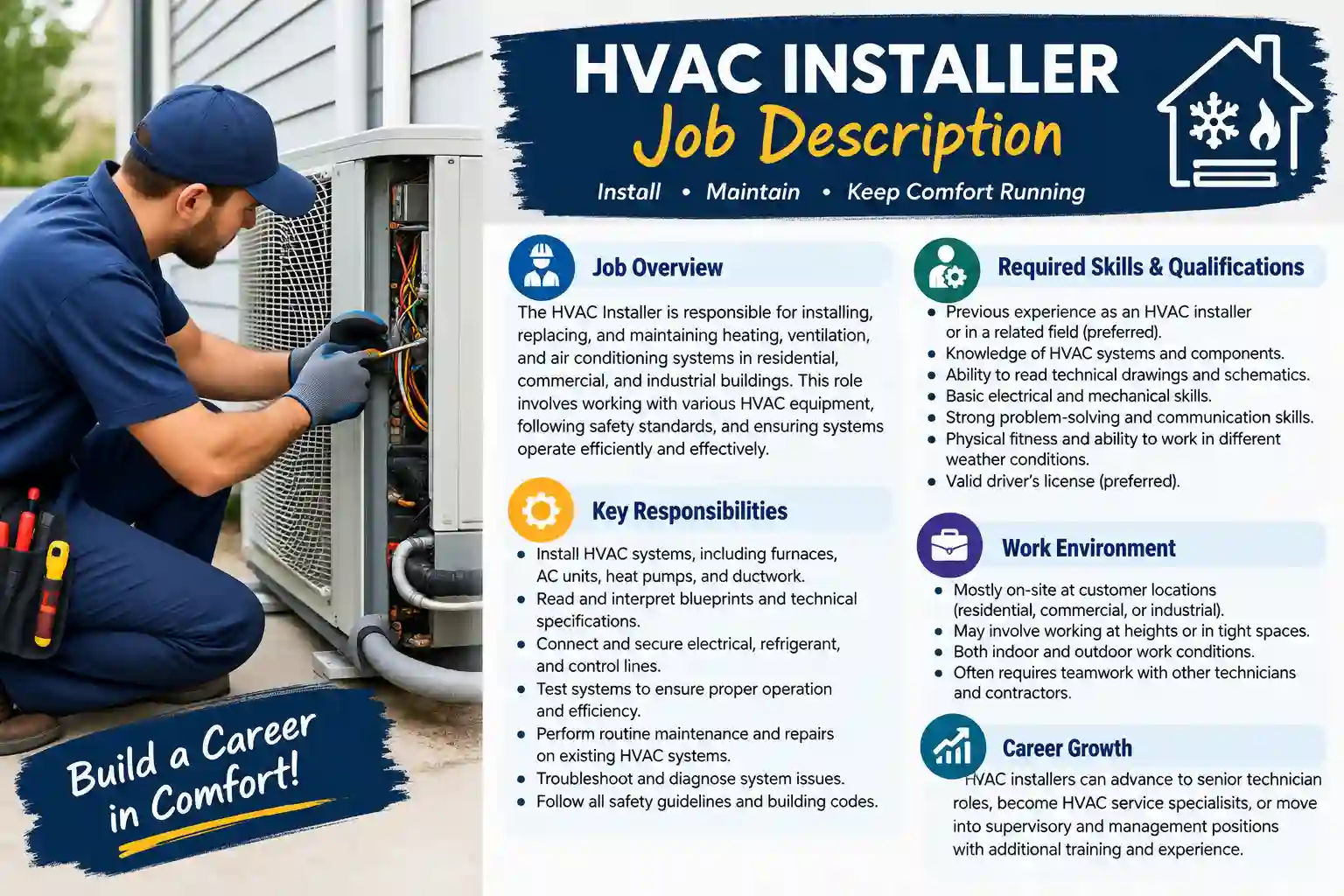
An HVAC installer job description explains the duties, skills, qualifications, and responsibilities needed to install heating, ventilation, and air conditioning systems. HVAC installers help homes and businesses maintain comfortable indoor temperatures by installing air conditioners, heating units, ventilation systems, and other climate control equipment.
HVAC installers work in houses, offices, schools, commercial buildings, and construction sites. Their daily tasks may include reading installation plans, fitting ductwork, connecting equipment, testing systems, and following safety procedures.
Whether you are looking for an HVAC installer job, preparing a resume, or hiring a qualified worker, understanding this role can help you make informed decisions. This guide covers HVAC installer duties, job description templates, salary factors, qualifications, resume examples, and career opportunities.
What Does an HVAC Installer Do?
An HVAC installer installs heating, ventilation, and air conditioning equipment in residential and commercial buildings. The main goal is to ensure that equipment is installed correctly and operates according to the manufacturer’s instructions and project requirements.
HVAC installers may work on new construction projects, equipment replacements, or building upgrades. Their responsibilities depend on the type of system, employer, and level of experience.
Common HVAC installer duties include:
- Installing air conditioners, heating units, and heat pumps.
- Fitting ventilation systems and ductwork.
- Measuring installation areas before placing equipment.
- Reading blueprints and technical drawings.
- Connecting system components according to approved plans.
- Installing thermostats and other required controls.
- Testing newly installed equipment.
- Checking connections and reporting installation problems.
- Maintaining tools and organizing work areas.
- Following safety rules and manufacturer instructions.
- Explaining basic equipment operation to customers.
Some HVAC installers also assist with maintenance and repairs. However, these responsibilities depend on the job description, training, and required authorization.

HVAC Installer Job Description Template
Employers can use this HVAC installer job description template to advertise a vacancy. It can be customized for residential, commercial, entry-level, or experienced installation positions.
Job Title: HVAC Installer
Job Summary
We are seeking a reliable HVAC installer to install heating, ventilation, and air conditioning systems in residential or commercial buildings. The successful candidate will prepare installation areas, fit equipment, connect system components, test performance, and follow workplace safety procedures.
The ideal candidate should have practical technical skills, attention to detail, and the ability to work independently or as part of a team.
Key Responsibilities
- Install heating, cooling, and ventilation equipment.
- Read blueprints, technical drawings, and installation instructions.
- Measure work areas and prepare installation materials.
- Install air conditioning units, heating systems, and heat pumps.
- Fit and connect ductwork and ventilation components.
- Install thermostats and other system controls.
- Check equipment connections and test system operation.
- Identify installation problems and report them to supervisors.
- Maintain tools and equipment in good working condition.
- Follow safety procedures and applicable building requirements.
- Communicate with coworkers, supervisors, and customers.
- Complete installation reports and other required paperwork.
Required Qualifications
- High school diploma or equivalent, where required.
- HVAC training or relevant practical experience.
- Basic knowledge of heating and cooling systems.
- Ability to use common installation tools safely.
- Understanding of workplace safety procedures.
- Good communication and problem-solving skills.
Preferred Qualifications
- Previous HVAC installation experience.
- Vocational training or apprenticeship experience.
- Relevant industry certifications.
- Experience with residential or commercial HVAC equipment.
- Ability to read technical drawings and equipment specifications.
Working Conditions
HVAC installers may work indoors, outdoors, on construction sites, or in mechanical rooms. The job can involve lifting equipment, climbing ladders, working in tight spaces, and standing for long periods.
Employers should include the work schedule, salary range, physical requirements, travel expectations, and benefits when these details are available.

HVAC Installer Duties and Responsibilities
HVAC installer duties vary according to the equipment and project. Most positions involve preparing the installation area, fitting equipment, connecting components, testing operation, and ensuring that work meets the required standards.
Installing HVAC Equipment
Installers position and secure air conditioners, heating units, heat pumps, and other equipment. They follow installation plans and manufacturer instructions to ensure that the equipment is fitted correctly.
Measuring and Installing Ductwork
Ductwork carries conditioned air throughout a building. HVAC installers may measure, cut, fit, connect, and seal ducts according to project specifications.
Correct duct installation helps support proper airflow and system performance.
Connecting System Components
Depending on the equipment and their qualifications, installers may connect thermostats, drainage lines, refrigerant piping, and other required components. Electrical and refrigerant-related tasks must follow applicable safety requirements and authorization rules.
Testing Installed Systems
After installation, workers check whether the system operates as expected. Testing may involve checking controls, airflow, drainage, connections, and other system functions.
If a problem appears, the installer reports it or corrects it within the scope of their training and responsibilities.
Following Safety Procedures
HVAC installers use appropriate protective equipment and follow workplace safety rules. They must take care when working with electrical components, heavy equipment, ladders, and refrigerants.
Communicating With Customers
Some installers explain basic equipment operation to customers, including thermostat use and routine maintenance needs. Clear communication helps customers understand how to operate their new systems.
HVAC Installer Skills and Qualifications
HVAC installers need practical skills, technical knowledge, and attention to detail. Employers may provide training for beginners, while experienced positions may require the ability to complete installations with less supervision.
Important HVAC installer skills include:
- Technical knowledge: Understanding basic heating, cooling, and ventilation systems.
- Tool handling: Using drills, wrenches, screwdrivers, and measuring tools correctly.
- Measuring skills: Taking accurate measurements before installing equipment.
- Problem-solving: Identifying installation issues and finding suitable solutions.
- Attention to detail: Following instructions and checking connections carefully.
- Communication: Working effectively with customers and team members.
- Time management: Completing tasks according to project schedules.
- Physical ability: Handling equipment and working in different environments.
- Safety awareness: Following workplace procedures and using protective equipment.
Education and Training
Many employers prefer a high school diploma or equivalent. Others may require vocational training, an HVAC course, an apprenticeship, or previous work experience.
HVAC training may cover heating systems, air conditioning, refrigeration, ventilation, electrical basics, equipment installation, and workplace safety.
Requirements vary by employer and location. Some tasks require specific certifications, licenses, or authorization.
HVAC Installer Job Description for Resume
An HVAC installer resume should show the candidate’s practical experience, technical abilities, training, and relevant qualifications. Employers want to understand what equipment a candidate has worked with and which installation tasks they can perform.
Experienced HVAC Installer Resume Example
Professional Summary
Reliable HVAC installer with experience in heating and cooling equipment installation, ductwork, system testing, and workplace safety. Skilled in using installation tools, following technical instructions, and working with team members to complete projects.
Work Experience
HVAC Installer
- Installed air conditioning and heating equipment in residential buildings.
- Measured and fitted ductwork according to project plans.
- Assisted with thermostat installation and system testing.
- Checked equipment connections and reported installation issues.
- Maintained tools and followed workplace safety procedures.
- Coordinated with coworkers to complete installation projects.
Use only the duties that match your actual work experience.
Entry-Level HVAC Installer Resume Example
Professional Summary
Motivated entry-level HVAC installer seeking an opportunity to develop practical skills in heating, ventilation, and air conditioning installation. Familiar with basic HVAC concepts, common tools, and workplace safety through training or supervised practice.
Relevant Skills
- Basic HVAC system knowledge.
- Tool handling and measurement.
- Ability to follow technical instructions.
- Teamwork and communication.
- Safety awareness.
- Willingness to learn new installation procedures.
Candidates without professional experience can include vocational courses, apprenticeships, practical training, and supervised projects.
HVAC Installer Job Description for CV
An HVAC installer CV should present relevant education, work history, technical skills, and qualifications in a clear format.
A useful CV structure includes:
- Contact information.
- Professional summary.
- Work experience.
- Technical skills.
- Education and training.
- Relevant certifications.
- References, if requested.
Use specific examples rather than general statements. For example, explain whether you installed air conditioners, fitted ductwork, tested equipment, or assisted experienced technicians.
If you need an HVAC installer job description PDF, you can prepare the job description in a document editor and export it as a PDF. Employers can use a PDF template to share vacancies, while job seekers can refer to job descriptions when preparing applications.
HVAC Installer Salary and Job Responsibilities
An HVAC installer salary depends on location, experience, employer, qualifications, and the type of installation work. Entry-level workers may begin as helpers or apprentices, while experienced installers may handle more complex projects or supervise other workers.
When comparing an HVAC job description and salary, consider the complete employment offer instead of looking at pay alone.
Factors that can affect compensation include:
- Years of experience.
- Type of HVAC equipment installed.
- Residential or commercial work.
- Technical training and certifications.
- Work schedule and overtime.
- Employer benefits.
- Travel requirements.
- Leadership responsibilities.
For accurate salary information, check current wage data for the specific country or region where the position is located. Pay can vary significantly between areas, so a single salary figure should not be treated as universal.

Residential and Commercial HVAC Installer Jobs
HVAC installers may work in residential properties or commercial buildings. Their responsibilities depend on the equipment, building layout, and installation requirements.
Residential HVAC Installer Job Description
A residential HVAC installer works in houses, apartments, and other homes. The job commonly involves installing air conditioners, heating equipment, heat pumps, thermostats, and ventilation components.
Responsibilities may include:
- Inspecting the installation area.
- Installing residential heating and cooling equipment.
- Fitting ductwork and ventilation components.
- Checking system operation after installation.
- Explaining basic equipment use to homeowners.
- Keeping tools and work areas organized.
Residential installers need practical skills and good communication because they often work directly with homeowners.
Commercial HVAC Installer Job Description
A commercial HVAC installer works in offices, schools, shopping centers, hotels, factories, and other commercial properties.
Typical duties include:
- Installing commercial heating and cooling equipment.
- Fitting larger ductwork and ventilation systems.
- Reading technical drawings and installation plans.
- Coordinating with contractors and other trades.
- Testing equipment after installation.
- Reporting technical issues.
- Following site-specific safety requirements.
Commercial installations may involve larger systems and more complex building layouts. Employers may prefer candidates with relevant training or previous commercial HVAC experience.
HVAC Installer Helper and Apprentice Jobs
Helper and apprentice positions can provide a starting point for people who want to enter the HVAC industry.
HVAC Installer Helper Job Description
An HVAC installer helper supports experienced workers with basic installation tasks. Responsibilities may include preparing tools, organizing materials, moving equipment safely, cleaning work areas, and assisting with measurements.
Helpers must follow instructions and safety rules. They may gradually learn more technical tasks as their experience increases.
HVAC Installer Apprentice Job Description
An HVAC installer apprentice learns the trade through supervised work and technical training. Apprentices may assist with equipment installation, ductwork, system testing, and other tasks appropriate to their skill level.
An apprenticeship helps workers develop practical experience and understand how HVAC systems operate. Program requirements depend on the employer, training provider, and location.
Lead HVAC Installer Job Description
A lead HVAC installer has additional responsibilities beyond standard installation work. This role may involve coordinating a team, checking installation quality, organizing tasks, and communicating with supervisors.
Common responsibilities include:
- Reviewing installation plans.
- Assigning tasks to team members.
- Coordinating daily installation work.
- Checking completed work for quality.
- Helping resolve technical problems.
- Monitoring tools and materials.
- Supporting workplace safety.
- Reporting project progress.
Lead installers generally need strong technical skills, practical experience, and communication abilities. Some employers also require previous supervisory experience.
HVAC Duct Installer and Sheet Metal Installer Jobs
Ductwork distributes air throughout many heating and cooling systems. Duct installers and sheet metal installers help prepare and fit the components needed for ventilation.
HVAC Duct Installer Job Description
An HVAC duct installer measures, cuts, fits, connects, and seals duct sections according to project plans. The worker may also inspect connections and help identify problems that affect airflow.
Important skills include accurate measuring, reading technical drawings, tool handling, and following safety procedures.
HVAC Sheet Metal Installer Job Description
An HVAC sheet metal installer works with metal components used in ducts and ventilation systems. Duties may include measuring, cutting, shaping, assembling, and fitting metal sections.
These workers must understand how to use relevant tools safely and follow project measurements and specifications.
HVAC Technician Job Description
An HVAC technician works with heating, ventilation, air conditioning, and refrigeration equipment. Depending on the role, the technician may install new systems, inspect existing equipment, perform maintenance, and troubleshoot faults.
HVAC technician duties and responsibilities commonly include:
- Inspecting heating and cooling equipment.
- Checking system performance.
- Identifying equipment problems.
- Performing routine maintenance.
- Replacing approved components.
- Testing equipment after service.
- Maintaining service records.
- Explaining problems to customers.
Some technicians specialize in maintenance and repair, while others also install equipment. Employers should clearly explain the duties and qualifications required for the position.
If you need an HVAC technician duties and responsibilities PDF, include the job title, summary, responsibilities, qualifications, skills, and safety requirements in the document.

Split AC Technician Job Description
A split AC technician installs and services air conditioning systems with separate indoor and outdoor units. These systems are common in houses, apartments, offices, and small commercial buildings.
Typical responsibilities may include:
- Checking the installation location.
- Mounting indoor and outdoor units securely.
- Preparing drainage and required system connections.
- Installing refrigerant piping where qualified and authorized.
- Checking electrical connections within the worker’s authorization.
- Testing cooling operation after installation.
- Identifying installation problems.
- Explaining basic system operation to customers.
A split AC technician must follow manufacturer instructions and applicable safety requirements. The exact responsibilities depend on the worker’s training, experience, and local regulations.
HVAC Installation vs. HVAC Repair
HVAC installation and repair are related, but they focus on different tasks.
| HVAC Installation | HVAC Repair |
| Focuses on setting up new equipment. | Focuses on identifying and fixing faults. |
| May include mounting units and fitting ductwork. | May include inspecting faulty components. |
| Involves connecting required system components. | May involve repairing or replacing approved parts. |
| Includes testing newly installed equipment. | Includes testing equipment after repair. |
| Often follows construction or equipment replacement. | Often follows a breakdown or service request. |
Some HVAC workers perform both installation and repair duties. Their responsibilities depend on training, experience, employer requirements, and the type of position.
HVAC Tools and Equipment
HVAC installers use tools to measure, fit, secure, and test system components.
Common tools include:
- Measuring tapes and levels.
- Screwdrivers and wrenches.
- Drills and suitable fasteners.
- Pliers and approved cutting tools.
- Ladders and appropriate lifting equipment.
- Safety glasses, gloves, and other protective equipment.
Depending on the job, workers may also use thermometers, multimeters, pressure gauges, and specialized testing instruments. Tools should be used only for tasks the worker is trained and authorized to perform.
Knowing how to handle tools safely helps installers complete work accurately and reduce the risk of injuries or equipment damage.
HVAC Preventive Maintenance and Safety
Preventive maintenance helps HVAC equipment operate as intended and can reveal problems before they become more serious.
Common maintenance activities include checking air filters, inspecting visible ductwork, checking drainage, reviewing thermostat operation, and looking for signs of damage. More advanced inspections and repairs should be completed by qualified workers.
HVAC workers should follow manufacturer instructions, use suitable protective equipment, and keep their work areas organized. Electrical components, refrigerants, heavy equipment, and ladders require special attention to safety.
Following the correct procedures helps protect workers, customers, and equipment.
HVAC Certifications and Training Requirements
HVAC certification and training requirements vary by country, state, and employer. Some employers accept entry-level candidates who are willing to learn, while others prefer vocational training, apprenticeship experience, or relevant industry credentials.
Before applying for an HVAC installer or technician position, candidates should:
- Review the employer’s education requirements.
- Check local licensing regulations.
- Identify any required certifications.
- Complete relevant technical training.
- Keep records of qualifications they have earned.
Training can help workers understand equipment operation, installation methods, troubleshooting, and workplace safety. Candidates should list only certifications they actually hold on their resumes and CVs.
HVAC Career Path: From Helper to Lead Installer
HVAC workers can develop their careers by gaining experience, completing training, and improving their technical skills.
A possible career path includes:
- HVAC helper: Assists experienced workers and prepares tools and materials.
- HVAC apprentice: Learns installation and service skills through supervised work.
- HVAC installer or technician: Performs assigned installation, maintenance, or service tasks.
- Senior installer or technician: Handles more complex work and may support junior workers.
- Lead HVAC installer: Coordinates installation tasks and checks work quality.
- HVAC supervisor or contractor: May supervise projects or run an HVAC business, subject to applicable requirements.
Not every employer uses the same job titles or career structure. Progression depends on experience, training, qualifications, performance, and available opportunities.

How to Write an Effective HVAC Installer Job Description
Employers should make their job descriptions clear and specific so candidates can understand the position before applying.
Follow these steps:
- Choose a clear job title. State whether the position is for an installer, helper, apprentice, or lead installer.
- Write a job summary. Explain the main purpose of the role.
- List daily responsibilities. Include the installation tasks the employee will actually perform.
- Separate required and preferred qualifications. Make essential requirements easy to identify.
- Explain working conditions. Mention physical requirements, travel, location, and schedule where relevant.
- Include compensation details. Provide salary or hourly pay and benefits when available.
- Explain how to apply. Tell candidates which documents and information to submit.
Avoid adding unrelated duties or qualifications that are not necessary for the position.
Frequently Asked Questions
An HVAC installer may prepare equipment, install heating and cooling units, fit ductwork, connect system components, test equipment, and follow safety procedures. Daily tasks depend on the project and employer.
An HVAC installer resume should include relevant experience, technical skills, training, education, and certifications. Beginners can highlight apprenticeships, vocational courses, and supervised practical experience.
An HVAC installer usually focuses on installing equipment, while an HVAC technician may focus more on inspection, maintenance, and troubleshooting. Some positions combine both sets of responsibilities.
Yes, some employers offer helper, apprentice, or entry-level positions. These roles allow candidates to develop practical skills under appropriate supervision.
A lead HVAC installer coordinates installation tasks, guides team members, checks work quality, and helps ensure that projects follow installation plans and safety procedures.
A split AC technician installs and services split air conditioning systems. Duties may include mounting units, preparing connections, testing system operation, and identifying installation problems.
HVAC installer pay depends on location, experience, employer, qualifications, and job duties. Candidates should check current salary information for the specific region where they plan to work.
Some positions require specific training, licenses, or certifications, particularly for regulated electrical or refrigerant-related tasks. Requirements depend on local laws and job responsibilities.
Yes. You can copy the job description into a document editor and use its export or save-as-PDF feature. Employers can customize the document for their vacancies, while job seekers can use it as a reference when preparing applications.
Final Thoughts
An HVAC installer job description explains the duties, skills, qualifications, and working conditions involved in installing heating, ventilation, and air conditioning systems. It helps employers identify suitable candidates and helps job seekers understand what a position requires.
Learning about HVAC technician responsibilities, salary factors, training, certifications, preventive maintenance, and career progression provides a broader understanding of the industry. Whether you are applying for an entry-level job or hiring an experienced installer, a clear job description helps everyone understand the role and its expectations.

Ryan Mitchell writes job descriptions, role overviews and general description guides in plain, easy-to-follow language. He focuses on listing duties, skills and requirements clearly, so readers can understand a role or topic without wading through jargon.