
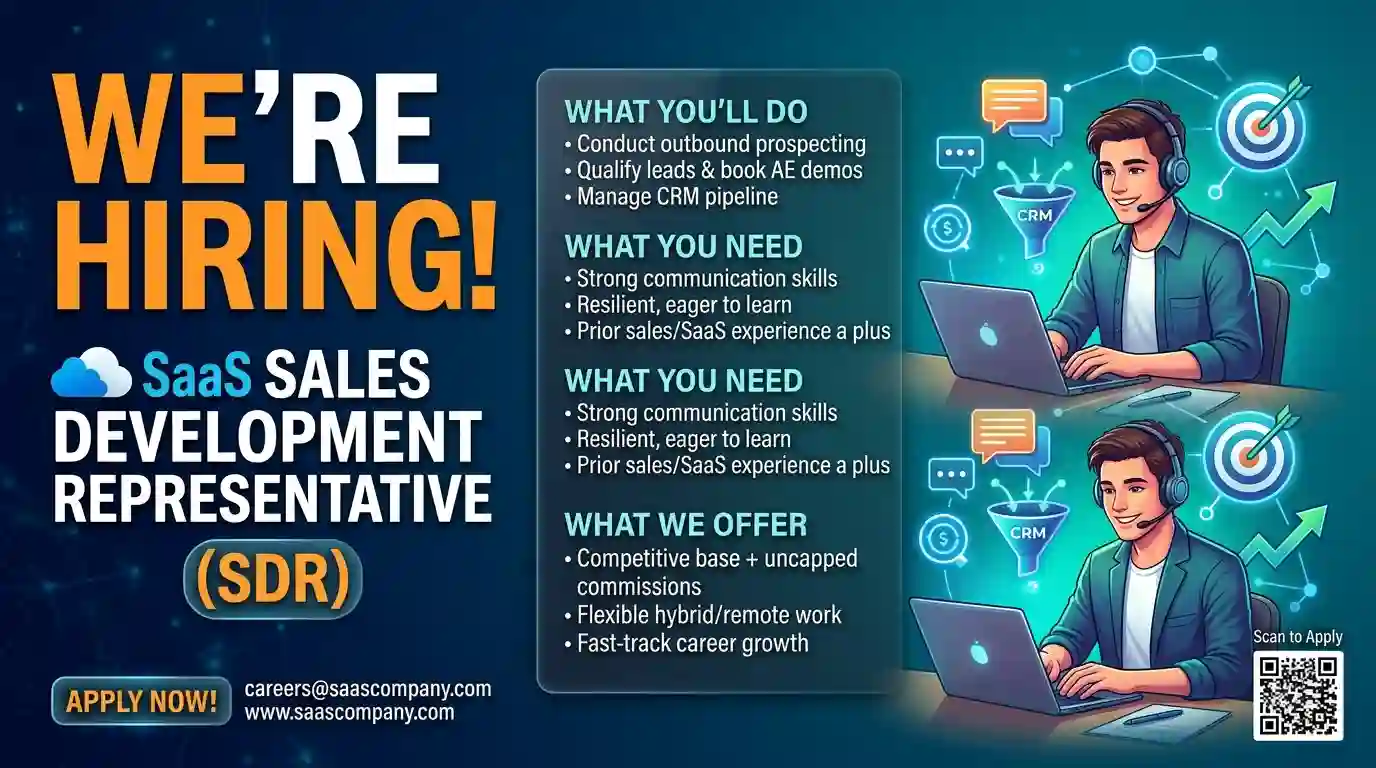
A SaaS Sales Development Representative (SDR) helps a software company find new customers and create sales opportunities. This role focuses on finding potential customers, starting conversations, and booking meetings for the sales team.
A SaaS SDR does not usually close the final sale. Instead, the SDR helps qualified prospects move to the next step in the sales process. This may include a meeting or product demo with an Account Executive (AE).
If you want to hire a SaaS SDR or apply for this job, this guide explains the job description, daily tasks, required skills, tools, salary, and career path.
What Does SDR Stand For?
SDR stands for Sales Development Representative. An SDR is a sales professional who finds and qualifies potential customers before passing them to the next stage of the sales process.
In a SaaS company, an SDR helps sell software that customers use online through a subscription. The SDR learns about customer needs, explains the basic value of the software, and checks whether a prospect may be a good fit.
For example, a company that sells project management software may hire an SDR to contact businesses that need better tools for managing their teams.
What Is a SaaS SDR Role?
A SaaS SDR role focuses on generating leads and building a strong sales pipeline for a software company. The SDR researches potential customers, contacts them, and checks whether they are interested in the company’s product.
SaaS SDRs may work with inbound leads, outbound prospects, or both.
- Inbound SDR: Contacts people who have already shown interest in the software.
- Outbound SDR: Reaches out to potential customers who may not know about the company yet.
The SDR works closely with Account Executives and the marketing team. Marketing may bring in leads through website content, online campaigns, and product sign-ups. The SDR then follows up, qualifies those leads, and books suitable meetings.

SaaS SDR Job Description Template
Here is a simple SaaS SDR job description template that employers can use when creating a job post.
Job Title: SaaS Sales Development Representative
Job Summary
We are looking for a motivated Sales Development Representative to help our SaaS company find new business opportunities. The successful candidate will research potential customers, contact prospects, qualify leads, and schedule meetings for the sales team.
The ideal candidate should have strong communication skills, an interest in technology, and the ability to understand customer needs.
Key Responsibilities
- Research potential customers and target businesses.
- Generate new leads through inbound and outbound sales activities.
- Contact prospects through phone calls, emails, and social selling.
- Use LinkedIn Sales Navigator and other prospecting tools to identify suitable contacts.
- Understand customer pain points and explain how the software may help.
- Ask questions to qualify leads based on their needs, budget, and buying plans.
- Follow up with prospects who have not responded.
- Schedule sales meetings and product demonstrations for Account Executives.
- Keep customer details and sales activities updated in a CRM system.
- Work with the marketing team to improve lead quality.
- Track sales activities, conversion rates, and other key performance indicators.
- Maintain accurate records of conversations and follow-up tasks.
Required Qualifications
- Strong written and verbal communication skills.
- Good research and organization skills.
- Confidence in speaking with new people.
- Ability to handle rejection and keep working toward goals.
- Basic knowledge of sales and lead generation.
- Interest in SaaS products and technology.
- Willingness to learn sales tools and processes.
Previous sales experience may be helpful, but some companies hire entry-level candidates and provide training.
What Does a SaaS SDR Do Every Day?
A SaaS SDR follows a daily workflow to find potential customers and create qualified sales opportunities.
1. Research Potential Customers
The SDR identifies businesses and people who may need the company’s software. Research may include company size, industry, job titles, current challenges, and possible buying needs.
Tools such as LinkedIn Sales Navigator can help SDRs find relevant contacts and learn about their professional roles.
2. Generate Leads
Lead generation means finding people or businesses that may become customers. SDRs may find leads through website sign-ups, marketing campaigns, business directories, referrals, or outbound prospecting.
The goal is to find prospects who match the company’s target customer profile rather than contacting random people.
3. Contact Prospects
SDRs contact prospects through cold calling, email outreach, and social selling. They may use personalized messages to explain why the software could be relevant to a prospect’s work.
For example, an SDR may contact a sales manager whose team needs a better way to track customer conversations.
4. Qualify Leads
Lead qualification helps an SDR decide whether a prospect is a good fit for the product. The SDR asks questions about the prospect’s needs, challenges, budget, decision-making process, and expected timeline.
Some sales teams use the BANT framework:
- Budget: Can the prospect afford the product?
- Authority: Is the prospect involved in making the buying decision?
- Need: Does the prospect have a problem the software can solve?
- Timeline: When does the prospect plan to make a decision?
BANT is one qualification method. Companies may use different questions depending on their products and sales process.
5. Follow Up With Prospects
Many prospects do not reply to the first message. SDRs follow up with helpful emails, calls, or other suitable communication.
Follow-ups should be polite and relevant. The goal is to start a useful conversation, not to pressure someone into buying.
6. Schedule Meetings
When a prospect meets the company’s qualification criteria, the SDR schedules a meeting or product demo with an Account Executive.
The SDR shares important notes about the prospect’s needs and challenges so the AE can prepare for the conversation.
7. Update the CRM
SDRs record calls, emails, meeting details, and prospect information in a Customer Relationship Management (CRM) system. This helps the sales team track each lead and understand what should happen next.

Inbound SDR vs. Outbound SDR
Both inbound and outbound SDRs help create sales opportunities, but they find prospects in different ways.
Inbound SDR
An inbound SDR works with people who have already shown interest in the company’s product. These leads may come from a website form, a product trial, a webinar, or a marketing campaign.
Typical tasks include:
- Responding to new inquiries.
- Contacting people who request a demo.
- Understanding what the prospect needs.
- Qualifying leads.
- Booking meetings for Account Executives.
Outbound SDR
An outbound SDR takes the first step by contacting potential customers. These prospects may not have visited the company’s website or asked for information.
Typical tasks include:
- Researching target companies.
- Finding relevant decision-makers.
- Making cold calls.
- Sending personalized emails.
- Using social selling to start conversations.
- Following up with prospects.
- Booking qualified meetings.
Some SaaS companies combine both types of work in one SDR role.
SaaS SDR vs. BDR vs. Account Executive
These sales roles work together, but their responsibilities can differ from one company to another.
Sales Development Representative (SDR)
An SDR focuses on lead generation, prospecting, lead qualification, and booking meetings. The role helps create opportunities for the sales team.
Business Development Representative (BDR)
A Business Development Representative (BDR) often focuses on outbound prospecting and finding new business opportunities. In some companies, BDR and SDR mean almost the same thing. In others, their duties are different.
Account Executive (AE)
An Account Executive usually manages qualified opportunities, leads sales conversations, gives product demonstrations, discusses pricing, and works toward closing deals.
The SDR-to-AE handoff is important. The SDR should provide clear notes about the prospect’s goals, needs, challenges, and previous conversations.
SaaS SDR Skills and Qualifications
A successful SaaS SDR needs communication skills, research skills, product knowledge, and the ability to manage daily sales activities.

Communication Skills
SDRs must explain ideas clearly through phone calls, emails, and online meetings. Good listening skills are also important because they help SDRs understand customer needs.
Research and Prospecting
SDRs need to identify the right people to contact. They should understand the company’s target market and research prospects before sending messages.
Lead Qualification
An SDR should know how to ask useful questions and identify whether a prospect is a good fit. This includes understanding customer pain points, buying needs, budget, and decision-making authority.
Resilience and Adaptability
Sales development includes unanswered emails and rejected calls. SDRs need to stay professional, learn from feedback, and adjust their approach when necessary.
Time Management
SDRs often manage many leads at once. They must plan calls, schedule follow-ups, update the CRM, and respond to interested prospects on time.
SaaS Product Knowledge
SDRs should understand what the software does, which problems it solves, and who benefits from using it. They do not need to know every technical detail, but they should explain the product’s main value clearly.

Teamwork
SDRs work with Account Executives, sales managers, and the marketing team. Sharing feedback can help improve messaging, lead quality, and the overall sales process.
Tools Used by SaaS SDRs
SaaS SDRs use different tools to research prospects, manage leads, send messages, and track results.
- Salesforce: A CRM platform used to manage customer information, sales activities, and opportunities.
- HubSpot: A platform with CRM and sales tools that can help teams organize contacts and follow up with leads.
- LinkedIn Sales Navigator: A prospecting tool that helps sales professionals find relevant business contacts.
- Outreach: A sales engagement platform used to organize outreach activities and follow-ups.
- Mailshake: A tool used for email outreach and sales communication.
- CRM software: Keeps lead records, notes, tasks, and sales pipeline information in one place.
- Analytics and reporting tools: Help teams measure activities and review performance.
The exact tools depend on the company. An entry-level SDR may learn these systems during onboarding.
SaaS SDR KPIs and Performance Metrics
Key performance indicators (KPIs) help sales managers understand an SDR’s performance. The right measures depend on the company’s sales strategy and the type of leads the SDR handles.
Common SaaS SDR KPIs include:
Number of Calls and Emails
These measures show how many prospects an SDR contacts. Activity numbers are useful, but they do not show the full quality of the work.
Qualified Meetings Booked
This measures how many meetings the SDR schedules with prospects who meet the company’s qualification criteria.
Meeting Show Rate
The meeting show rate measures how many scheduled meetings actually take place.
Lead-to-Meeting Conversion Rate
This metric shows how effectively an SDR turns leads into scheduled meetings.
Sales Pipeline Contribution
This measures the value of sales opportunities created through the SDR’s work. Some companies track the pipeline value associated with qualified meetings or opportunities.
Lead Quality
Lead quality reflects how well the prospects match the target customer profile and whether they are likely to become suitable sales opportunities.
Managers should consider both activity and results. A large number of calls does not always mean an SDR is creating valuable opportunities.
SaaS SDR Salary and Commission Structure
A SaaS SDR’s salary depends on the company, location, experience, market, and compensation plan. Entry-level roles may offer a lower base salary, while experienced SDRs may earn more.
Many SaaS sales roles use a compensation structure that includes:
- Base salary: The fixed amount paid for the job.
- Commission or variable pay: Additional pay based on agreed performance goals.
- On-target earnings (OTE): The expected total compensation when the employee achieves the required targets.
For example, a company may set targets based on qualified meetings, accepted opportunities, or other sales development results. The exact commission plan varies by employer.
Before accepting a job, candidates should check the base salary, OTE, performance targets, commission rules, and payment schedule. They should also ask whether targets are based on meetings booked, meetings attended, or opportunities accepted by the sales team.
How to Become a SaaS SDR
You can prepare for a SaaS SDR job by learning basic sales skills and practicing how to communicate with potential customers.

1. Learn the Basics of SaaS
Understand how subscription software works and how SaaS companies sell products to businesses. Learn common terms such as leads, prospects, sales pipeline, conversion rate, and customer relationship management.
2. Build Communication Skills
Practice writing clear emails, making short introductions, asking useful questions, and explaining product benefits in simple language.
3. Learn Prospecting
Study how to research companies, identify decision-makers, and find people who may need a product. Learn how to personalize outreach rather than sending the same message to everyone.
4. Understand CRM Tools
Get familiar with basic CRM tasks, including adding contacts, recording conversations, setting reminders, and updating lead stages.
5. Practice Lead Qualification
Use simple questions to understand a prospect’s needs, budget, decision-making role, and timeline. Learn how to recognize a qualified lead.
6. Apply for Entry-Level Jobs
Look for SDR, Sales Development Representative, or junior sales development positions. Tailor your resume to highlight communication, research, customer service, organization, and relevant technology skills.
SaaS SDR Interview Questions and Answers
Employers may ask questions to check your communication skills, sales knowledge, and ability to handle rejection.
1. What Does SDR Stand For?
SDR stands for Sales Development Representative. An SDR finds potential customers, qualifies leads, and schedules meetings for the sales team.
2. Why Do You Want to Work as a SaaS SDR?
I want to develop my sales and communication skills while learning how software companies help customers solve business problems. I also enjoy research, talking to people, and working toward clear goals.
3. How Would You Find Potential Customers?
I would first learn about the company’s target customers. Then I would research suitable businesses and decision-makers, use prospecting tools, and contact relevant people through personalized emails, calls, or professional social platforms.
4. How Would You Handle Rejection?
I would stay professional and avoid taking rejection personally. I would review my approach, learn from feedback, and continue focusing on suitable prospects.
5. How Do You Qualify a Lead?
I would ask questions about the prospect’s needs, current challenges, budget, decision-making process, and timeline. I would then compare the answers with the company’s qualification criteria.
6. What Is the Difference Between an SDR and an Account Executive?
An SDR mainly finds and qualifies leads and books meetings. An Account Executive usually manages qualified opportunities, presents the product, discusses the deal, and works toward closing the sale.
SaaS SDR Career Path
A SaaS SDR role can be a starting point for a career in sales or other customer-facing business roles.
Possible career paths include:
- Senior SDR: Handles more complex prospecting work and may help train newer team members.
- Business Development Representative: Focuses on developing new business opportunities, often through outbound prospecting.
- Account Executive: Manages sales opportunities and works to close deals.
- Sales Development Manager: Leads an SDR team, coaches employees, reviews performance, and helps improve sales processes.
- Sales Operations: Helps improve sales systems, reporting, processes, and performance data.
Career growth depends on performance, experience, company structure, and available opportunities.

SaaS SDR Resume and Cover Letter Tips
A strong resume should show that you can communicate clearly, organize tasks, research information, and work toward goals.
Include relevant skills such as:
- Lead generation and prospecting.
- Written and verbal communication.
- Customer service.
- Research and organization.
- CRM knowledge.
- Email outreach and follow-up.
- Time management.
- Problem-solving.
If you have previous sales experience, include measurable results where possible. If you are new to sales, highlight transferable skills from education, customer service, volunteering, or other work.
Your cover letter should explain why you want to work in SaaS sales and how your skills match the job description. Keep it focused on the employer and the value you could bring to the team.
SaaS SDR Onboarding: The First 30, 60, and 90 Days
A structured onboarding plan helps new SDRs understand the product, sales process, and performance expectations.
First 30 Days: Learn
- Learn the company’s product and target market.
- Understand common customer pain points.
- Study the sales process and qualification criteria.
- Learn the CRM and outreach tools.
- Listen to example calls and review successful emails.
Days 31–60: Practice
- Begin contacting suitable prospects.
- Practice cold calling and personalized email outreach.
- Learn to qualify leads and handle common objections.
- Review call and email feedback with a manager.
- Start tracking daily activities and early results.
Days 61–90: Improve
- Manage a regular prospecting routine.
- Improve outreach messages based on results.
- Work toward agreed meeting and qualification targets.
- Keep CRM records accurate.
- Review KPIs with the manager and identify areas for improvement.
The exact timeline varies by company, product complexity, and the experience of the new employee.
Frequently Asked Questions
An SDR job stands for Sales Development Representative. The role focuses on finding prospects, qualifying leads, and creating sales opportunities.
A SaaS SDR role involves helping a software company find potential customers, contact prospects, qualify leads, and schedule meetings for the sales team.
An SDR position stands for Sales Development Representative. The employee helps build the sales pipeline by identifying and qualifying potential customers.
In SaaS, SDR stands for Sales Development Representative. The role supports software sales by finding suitable prospects and arranging meetings with qualified leads.
A SaaS SDR job description explains the duties, skills, and qualifications needed to generate leads, conduct outreach, qualify prospects, maintain CRM records, and schedule sales meetings.
A SaaS SDR job is a sales development position at a software company. The main goal is to create qualified sales opportunities rather than usually closing the final deal.
Not always. Some employers hire entry-level candidates who have good communication, research, and organization skills. Other positions may require previous sales or SaaS experience.
Inbound SDRs respond to people who have already shown interest in the product. Outbound SDRs contact potential customers who may not have contacted the company before.
Final Thoughts
A SaaS Sales Development Representative helps a software company find potential customers and create qualified sales opportunities. The job includes prospecting, lead generation, outreach, qualification, follow-up, meeting scheduling, and CRM management.
Strong communication, research, time management, and resilience can help an SDR succeed. Learning tools such as Salesforce, HubSpot, and LinkedIn Sales Navigator can also help candidates prepare for the role.
Whether you are hiring an SDR or applying for your first SaaS sales job, understanding these responsibilities can help you set clear expectations and build a strong foundation for growth.

Ryan Mitchell writes job descriptions, role overviews and general description guides in plain, easy-to-follow language. He focuses on listing duties, skills and requirements clearly, so readers can understand a role or topic without wading through jargon.