

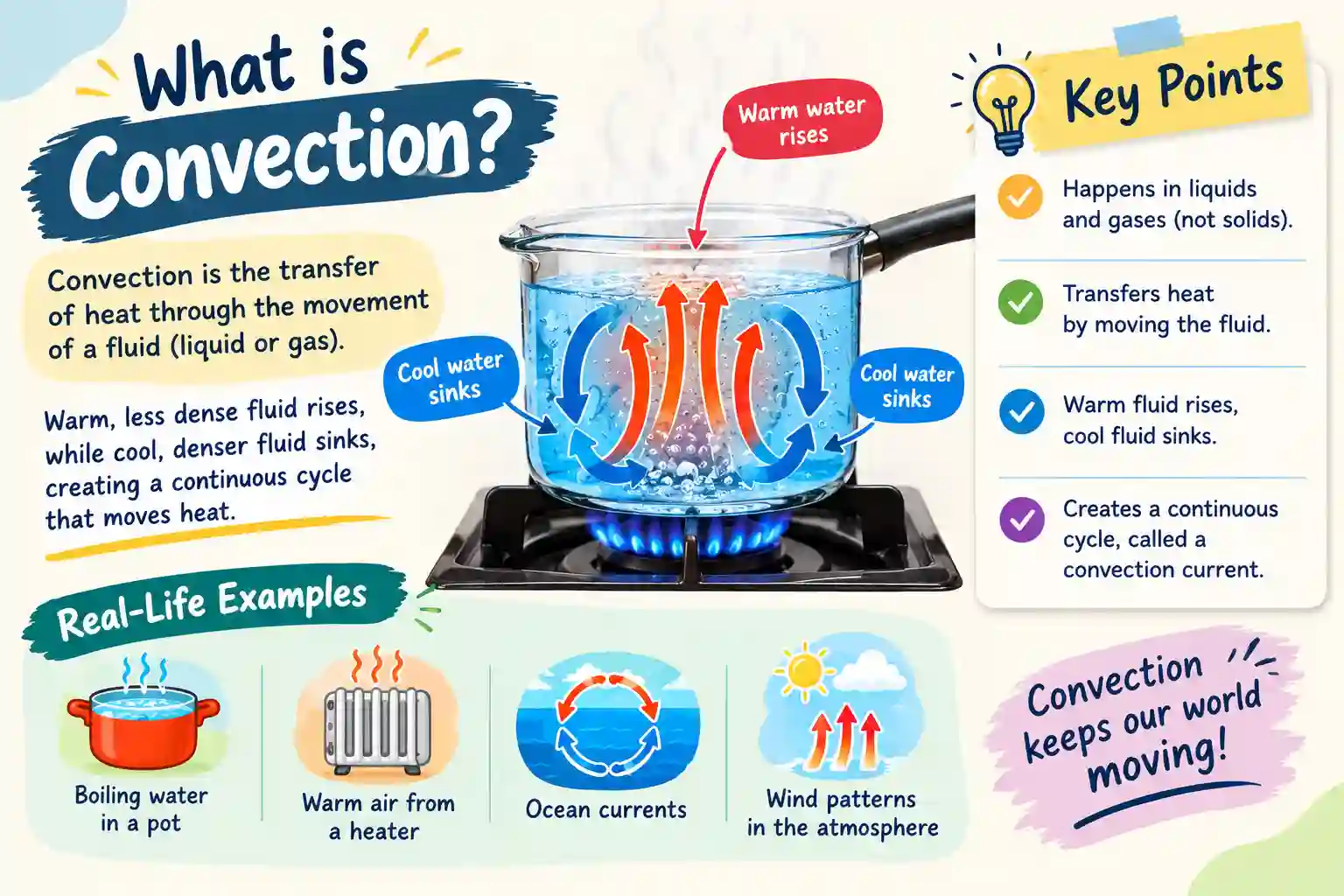
A description of convection explains how heat moves from one place to another through the movement of liquids and gases. Convection is an important process in physics because it helps transfer thermal energy in everyday activities, weather systems, cooking, and natural processes.
For example, when water is heated in a pot, warmer water rises while cooler water sinks. This movement creates convection currents that spread heat throughout the water.
Convection also occurs when warm air rises above a heater, a fan circulates hot air inside an oven, or warm air moves upward in the atmosphere. Understanding convection helps explain how heat travels through fluids and why this process matters in science and daily life.
What Is Convection?
Convection is a method of heat transfer that occurs through the bulk movement of a fluid. A fluid is a substance that can flow, such as a liquid or gas. Plasma can also carry thermal energy through convective movement in certain physical systems.
When a fluid is heated, its temperature and density may change. In many common situations, the warmer fluid becomes less dense and rises, while the cooler, denser fluid sinks. This movement transfers heat between different regions.
A simple example is boiling water. The water near the bottom of the pot receives heat first. As it warms, it rises, and cooler water moves downward to take its place. This cycle continues as long as the heating creates suitable temperature and density differences.
Description of Convection in Physics
The description of convection in physics focuses on how thermal energy moves through flowing fluids. Convection is one of the three main methods of heat transfer, along with conduction and radiation.
The process depends on several factors:
- Temperature difference: A difference in temperature can cause fluid movement.
- Density: Changes in temperature can change the density of a liquid or gas.
- Gravity and buoyancy: In many natural convection systems, buoyancy helps warmer, less-dense fluid rise.
- Fluid movement: Moving fluid carries thermal energy from one place to another.
Convection is important in physics, engineering, meteorology, and astronomy because it helps explain heat movement in systems ranging from cooking pots to stars.
How Does Convection Work?
Convection can be understood through the example of water heated from below.

1. Heat Is Applied
The stove transfers energy to the bottom of the pot, warming the water near the base.
2. Warmer Water Rises
The heated water becomes less dense under ordinary conditions and moves upward because of buoyancy.
3. Cooler Water Sinks
Cooler, denser water moves down to replace the rising water and receives heat from the bottom.
4. Convection Currents Form
The continuous circulation moves thermal energy through the water.
This is a common example of natural convection. The exact movement depends on the fluid, the heating arrangement, and the surrounding conditions.
What Are Convection Currents?
Convection currents are circulating movements of liquids or gases caused by differences in temperature and density. They transfer thermal energy by moving warmer fluid away from a heat source and bringing cooler fluid toward it.
Convection currents occur in several places:
- Boiling water in a pot
- Air circulating around a room heater
- Warm air rising in the atmosphere
- Ocean circulation driven partly by temperature and salinity differences
- Earth’s mantle
- The Sun’s convection zone
These currents help redistribute heat. In the atmosphere, convection can contribute to cloud development and thunderstorms. In Earth’s interior, mantle convection helps transport heat and is associated with plate tectonic movement.
Types of Convection
There are two main types of convection: natural convection and forced convection. A combination of the two can also occur.
Natural Convection
Natural convection occurs when fluid moves because of buoyancy caused by density differences, without a fan or pump forcing the movement.
For example, when a room heater warms the surrounding air, the warmer air often rises while cooler air moves toward the heater. This creates circulation.
Other examples include:
- Water circulating in a pot heated from below
- Warm air rising above sun-heated land
- Air movement near a warm wall
- Natural air circulation in some buildings
Forced Convection
Forced convection occurs when an external device moves a fluid. Fans, pumps, and blowers are common examples of devices used to create this movement.
Examples include:
- A fan circulating air through a computer
- A pump moving coolant through an engine
- An air conditioner circulating indoor air
- A convection oven moving hot air around food
Forced convection is widely used in engineering because controlling fluid movement can improve heat transfer.
Mixed Convection
Mixed convection occurs when both natural buoyancy and externally driven fluid movement affect the same heat-transfer process.
For example, air around a heated surface may rise naturally while a fan also pushes it in a particular direction. Both effects can influence the overall circulation.
Difference Between Convection, Conduction, and Radiation
Convection, conduction, and radiation are the three main methods of heat transfer. They differ in how thermal energy moves.
| Feature | Convection | Conduction | Radiation |
| How heat transfers | Through bulk fluid movement | Through particle interactions | Through electromagnetic waves |
| Requires a fluid? | Yes, for convection | No | No |
| Can work through a vacuum? | No | No | Yes |
| Common example | Circulating water in a pot | A metal spoon becoming hot in tea | Sunlight warming the Earth |
These methods can occur together. In a cooking pot, conduction transfers heat through the metal, convection circulates the water, and radiation may transfer energy from the flame or heating element.
Examples of Convection in Everyday Life
Convection occurs in homes, kitchens, the atmosphere, and many machines. The following examples show how this process works.

1. Boiling Water
Water heated near the bottom rises while cooler water sinks. This circulation helps spread heat through the liquid.
2. Heating a Room
Warm air near a heater rises, while cooler air moves down and toward the heat source. The movement helps distribute warmth.
3. Hot-Air Balloons
Heated air inside the balloon becomes less dense than the surrounding air. Buoyancy allows the balloon to rise.
4. Sea Breezes
During the day, land often heats faster than the sea. Warm air rises over land, and cooler air from the sea moves inland to replace it.
5. Convection Ovens
A fan circulates hot air around food. This forced convection helps transfer heat more evenly during cooking.
Convection Heat Transfer
Convection heat transfer describes the movement of thermal energy between a surface and a moving fluid, or through the circulation of a fluid itself.
For example, moving air can carry heat away from a warm object. Similarly, circulating water can transfer heat from a heating element to other parts of a container.
In basic engineering, the rate of convective heat transfer is often estimated using Newton’s law of cooling:
[
Q = hA(T_s-T_f)
]
Here:
- (Q) is the heat-transfer rate.
- (h) is the convective heat-transfer coefficient.
- (A) is the surface area.
- (T_s) is the surface temperature.
- (T_f) is the temperature of the surrounding fluid.
This equation shows that convection heat transfer depends on the temperature difference, surface area, and the heat-transfer coefficient. The coefficient is affected by factors such as fluid movement, fluid properties, and surface shape.
Engineers use these principles to design radiators, cooling systems, heat exchangers, and industrial equipment.
Applications of Convection
Convection has many applications in everyday life and science.
Cooking and Baking
Convection ovens use fans to circulate hot air around food. This can help distribute heat more evenly and may shorten cooking times, depending on the food and oven settings.
Heating and Cooling Systems
Heaters, air conditioners, and ventilation systems use moving air to distribute heat or remove it from indoor spaces.
Vehicle Cooling Systems
In many vehicles, coolant carries heat away from the engine. A radiator then transfers heat from the coolant to the surrounding air, with airflow helping the process.
Weather and Climate
Convection moves warm and cool air through the atmosphere. It contributes to cloud formation, thunderstorms, and other weather patterns.
Industrial Equipment
Factories use convection in furnaces, cooling systems, and heat exchangers to manage temperatures and transfer energy.
Electronics Cooling
Fans move air over computer components and other electronic devices to help remove unwanted heat.

Description of Convection Temperature
Temperature differences are a major reason convection occurs. When a fluid is heated, it may expand and become less dense. If the surrounding fluid is denser, buoyancy can make the warmer fluid rise.
As the fluid cools, its density may increase, allowing it to sink and complete a circulation pattern.
However, warm fluid does not always rise in every situation. The direction of movement depends on the fluid’s density, gravity, temperature distribution, and other physical conditions.
Description of a Convection Oven
A convection oven is an oven that uses a fan to circulate heated air around food. This circulation is an example of forced convection because a mechanical device moves the air.
Convection ovens are commonly used for:
- Baking cookies and pastries
- Roasting vegetables
- Cooking meat
- Heating food evenly
Their performance depends on the oven design, airflow, temperature, and the type of food being cooked.
Description of the Sun’s Convection Zone
The Sun’s convection zone is the outer region of its interior where energy is transported mainly by the movement of hot plasma.
Hot plasma rises toward the surface, releases energy, cools, and sinks again. This movement creates convection currents that carry energy outward.
The Sun’s convection zone is a scientific example of convection occurring on an enormous scale. Unlike water in a pot, the Sun consists of extremely hot plasma, but the basic principle of moving fluid transporting energy remains relevant.
Convectional Rainfall Description
Convectional rainfall occurs when the Sun heats the Earth’s surface, warming the moist air above it. The warm air rises and expands as the surrounding pressure decreases.
As the air rises, it cools. If it reaches the conditions needed for condensation, water vapor forms tiny droplets and clouds. When the droplets grow large enough, they fall as rain.
Convectional rainfall is common in warm, humid areas and can produce heavy showers or thunderstorms. Strong rising air can contribute to the development of tall cumulonimbus clouds.
Define Convection for Class 7
Convection is the transfer of heat in liquids and gases by the movement of the fluid.
For example, when water is heated in a pot, warm water rises and cooler water sinks. This movement forms convection currents and helps transfer heat through the water.
Students can remember three key points:
- Convection occurs in fluids, such as liquids and gases.
- Warmer fluid often rises while cooler, denser fluid sinks.
- Boiling water is a common example of convection.
Advantages and Limitations of Convection

Advantages
- It helps transfer heat through liquids and gases.
- It makes heating water and cooking food more effective.
- It supports heating, ventilation, and cooling systems.
- It helps remove heat from engines and electronic equipment.
- It contributes to atmospheric and oceanic circulation.
Limitations
- Convection requires a fluid to move.
- Natural convection may be slow when temperature differences are small.
- Heat-transfer efficiency depends on fluid properties and flow conditions.
- Convection cannot transfer heat across a vacuum through fluid movement.
- Unwanted air circulation can increase heat loss in buildings.
Frequently Asked Questions
Convection is the transfer of heat through the movement of liquids or gases. Warm fluid often rises while cooler, denser fluid sinks.
The best description of convection is the transfer of thermal energy through the bulk movement of a fluid, such as a liquid or gas.
Convection is a method of heat transfer in which moving fluid carries thermal energy from one place to another.
Boiling water is a common example. Warm water rises from the bottom of the pot while cooler water sinks and gets heated.
Convection currents are circulating movements of fluids caused by temperature and density differences. They help transport thermal energy.
Convection transfers heat through bulk fluid movement, while conduction transfers energy through particle interactions without bulk movement of the material.
Forced convection occurs when a fan, pump, or blower moves a fluid to help transfer heat.
Convection is used in cooking, heating and cooling systems, vehicle radiators, electronics cooling, and industrial heat exchangers. It also occurs in weather and natural systems.
The Sun’s convection zone is the region inside the Sun where moving plasma transports energy toward the surface.
Convectional rainfall occurs when warm, moist air rises, cools, condenses into clouds, and produces rain.
Ordinary convection requires bulk movement of material, so it occurs in fluids rather than rigid solids. Heat can still travel through solids by conduction.
Final Thoughts
The description of convection explains how thermal energy moves through fluids because of their physical movement. Temperature and density differences often create convection currents, while fans and pumps can produce forced convection.
Convection helps explain boiling water, room heating, convection ovens, weather patterns, ocean circulation, and energy transport inside the Sun. It is an essential concept in physics and engineering because it connects everyday experiences with larger natural processes.

Ryan Mitchell writes job descriptions, role overviews and general description guides in plain, easy-to-follow language. He focuses on listing duties, skills and requirements clearly, so readers can understand a role or topic without wading through jargon.