

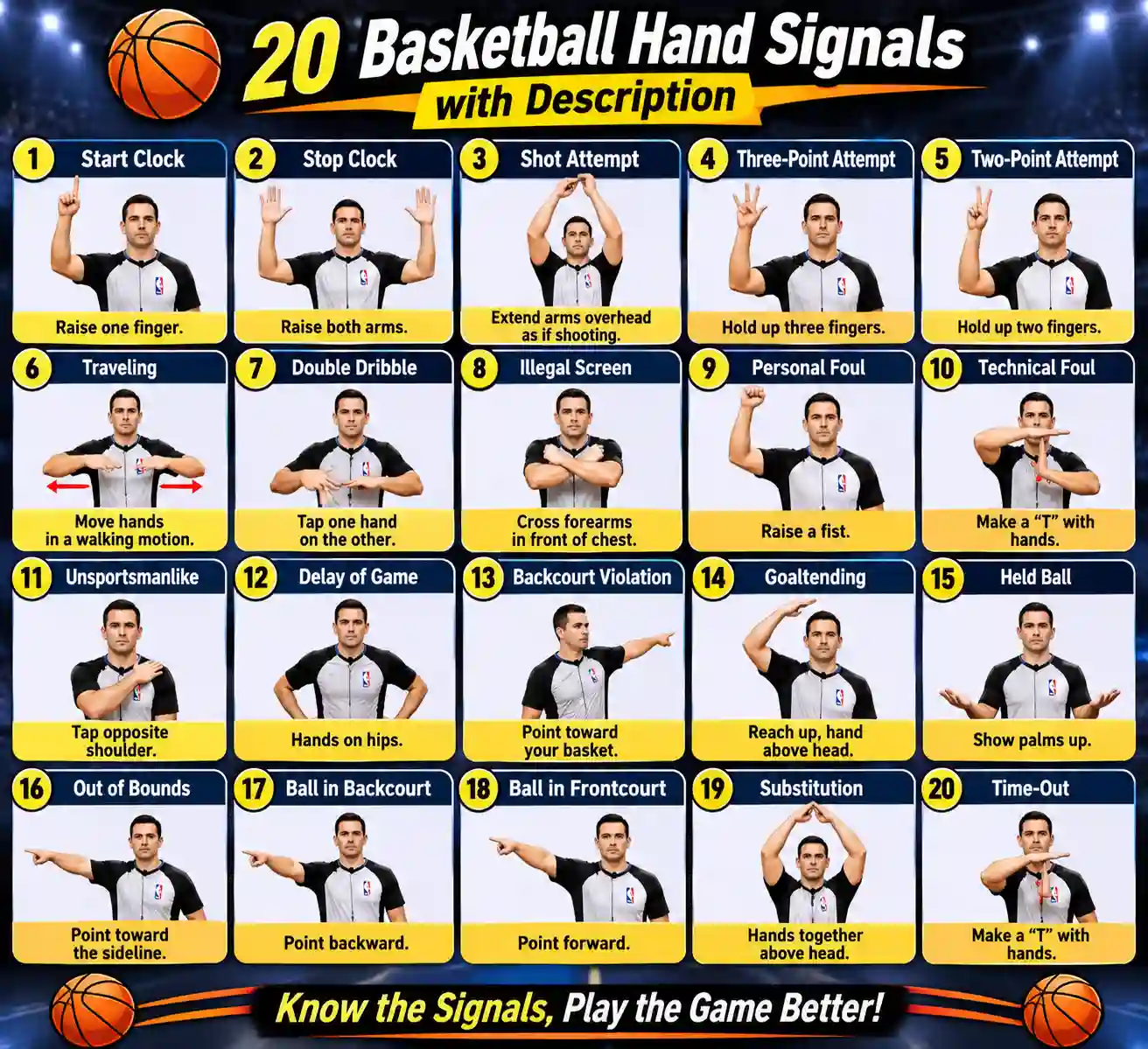
Basketball referees use hand signals to communicate decisions during a game. These gestures help players, coaches, and scorekeepers understand fouls, violations, scoring decisions, timeouts, and substitutions.
Learning the 20 hand signals in basketball with description makes it easier to understand how officials manage a game. From traveling and double dribbling to technical fouls and three-point baskets, every signal has a specific purpose.
Basketball referee hand signals also help officials communicate without stopping the game for long explanations. In this guide, you will learn 20 common signals, their meanings, and how they are used. You will also discover basketball foul signals, violation signals, clock signals, and useful PDF resources.
What Are Basketball Hand Signals?
Basketball hand signals are gestures that referees use to communicate decisions during a game. Officials move their hands and arms in specific ways to report fouls, violations, points, timeouts, and other game situations.
These basketball referee signals help everyone understand what is happening on the court. For example, a raised arm can indicate a three-point attempt, while a T-shaped gesture can communicate a timeout.

Referees also use whistles, verbal communication, and directional signals to manage possession and report decisions to the scorer’s table.
20 Hand Signals in Basketball With Description
Here are 20 common basketball referee hand signals and their meanings. Some gestures may vary between NBA, FIBA, and NFHS rules, so always follow the official signal chart used in your competition.
1. One-Point Signal
The referee raises one finger to indicate a successful one-point free throw. This gesture tells the scorekeeper to add one point to the team’s score.
Free throws are awarded after certain fouls and other situations under basketball rules.
2. Two-Point Signal
The referee raises two fingers on one hand to indicate a successful two-point basket.
This signal is used when a player scores from inside the three-point line. It helps the scorer’s table record the correct number of points.
3. Three-Point Attempt
The referee raises one arm with three fingers extended to show that a player is attempting a three-point shot.
This signal tells everyone that the player is shooting from behind the three-point line. It is an important part of basketball scoring signals.
4. Three-Point Successful Shot
When a player successfully scores from beyond the three-point line, the referee raises both arms with three fingers extended.
This gesture confirms that the basket counts for three points.
5. Traveling Violation
The referee rotates both closed fists around each other in front of the body to indicate traveling.
Traveling happens when a player moves their feet illegally while holding the ball without dribbling. It is one of the most common basketball violations.
6. Double Dribble
The referee moves both hands up and down in a dribbling motion to indicate a double-dribble violation.
This happens when a player starts dribbling again after stopping or dribbles with both hands at the same time.
7. Carrying or Palming
The referee uses a specific hand gesture to indicate that a player has illegally carried or palmed the ball.
Carrying happens when a player places their hand underneath the ball or allows it to rest in the hand while dribbling. This action gives the player an unfair advantage.

8. Personal Foul
The referee raises one closed fist above the head to indicate that a foul has occurred.
A personal foul involves illegal physical contact with an opponent. Common examples include blocking, holding, pushing, and illegal use of hands.
9. Blocking Foul
The referee places both hands on the hips to indicate a blocking foul under commonly used basketball officiating signals.
A blocking foul occurs when a defensive player makes illegal contact with an opponent without establishing a legal guarding position.
10. Charging Foul
The referee uses the official charging or player-control foul gesture to report illegal contact by an offensive player.
Charging happens when an offensive player illegally moves into a defender who has established a legal guarding position.
11. Holding Foul
The referee uses a wrist-grabbing gesture to indicate holding.
Holding occurs when a player uses their hands or arms to restrict an opponent’s movement. It can happen while defending, rebounding, or trying to gain possession of the ball.
12. Pushing Foul
The referee makes a pushing motion with both hands to indicate illegal pushing.
This foul occurs when a player pushes an opponent to gain an advantage or prevent their movement. It may happen during defense, rebounding, or a struggle for possession.
13. Illegal Use of Hands
The referee uses a specific wrist or hand gesture to indicate illegal use of hands.
This foul may occur when a defender makes illegal contact with an opponent’s arms or hands while trying to defend or take the ball.
14. Technical Foul
The referee forms a T-shaped gesture with one hand placed across the other.
A technical foul may be called for unsportsmanlike behavior, arguing with officials, or certain violations of game conduct rules.
The official reports the technical foul to the scorer’s table so the correct penalty can be recorded.
15. Intentional Foul
An intentional foul involves illegal contact that is not considered a legitimate attempt to play the ball.
The referee uses the designated intentional-foul gesture to report the decision. The exact signal and penalty should be checked in the official rulebook for the competition.
16. Double Foul
The referee uses the designated double-foul gesture to indicate that two opponents have committed fouls against each other at approximately the same time.
Officials then apply the appropriate possession and penalty rules. The scorer’s table records the fouls for the players involved.
17. Timeout Signal
The referee forms a T shape with both hands to indicate a timeout.
The time out hand signal in basketball tells players, coaches, and the scorer’s table that a timeout has been requested or granted.
A timeout gives teams an opportunity to discuss strategy, make adjustments, and rest players.
18. Substitution Signal
The referee uses a beckoning gesture to allow a substitute player to enter the court.
The substitution hand signal in basketball helps officials manage player changes. Substitutions must take place according to the rules of the competition.
19. Start and Stop Clock Signals
Referees use specific gestures to communicate with the timekeeper.
- Start clock: A chopping motion with the hand indicates that the game clock should start.
- Stop clock: A raised open hand indicates that the clock should stop.
These signals are important for time management and accurate game records.
20. No Basket Signal
The referee waves both arms across the body to indicate that a basket does not count.
This signal may be used when a violation or foul prevents a basket from counting. The official then communicates the decision and possession information when required.
Different Types of Basketball Referee Signals
Basketball referee signals can be divided into several groups. Learning these categories makes it easier to understand and remember different gestures.
Basketball Foul Signals and Their Meanings
Basketball foul signals communicate illegal physical contact or certain conduct violations. Referees use these gestures to report the type of foul to the scorer’s table.
Common basketball foul signals include:
- Personal foul
- Blocking foul
- Charging foul
- Holding foul
- Pushing foul
- Illegal use of hands
- Hand-checking foul
- Technical foul
- Intentional foul
- Double foul
- Elbow foul
- Excessive swinging of elbows
A foul can lead to free throws, a change in possession, or another penalty depending on the situation and the rules being followed.
Basketball Violation Signals With Pictures
Basketball violations happen when a player breaks a playing rule. Many violations do not involve illegal physical contact.
Common basketball violation signals include:
- Traveling
- Double dribble
- Carrying or palming
- Three-second violation
- Five-second violation
- Eight-second violation
- Ten-second violation
- 24-second shot clock violation
- Backcourt or over-and-back violation
- Kicking the ball
- Out-of-bounds violation
- Lane violation
Time limits for certain violations depend on the competition. For example, NBA and FIBA rules use different backcourt time limits.
Pictures beside each signal can help beginners understand the referee’s hand movements and remember the meaning of each gesture.
Basketball Scoring Signals
Scoring signals help referees communicate how many points a team has earned.
The main basketball scoring signals include:
- One-point signal for a successful free throw
- Two-point signal for a successful two-point basket
- Three-point attempt signal
- Three-point successful basket signal
- No-basket signal when a score does not count
These gestures help the scorer’s table record the correct score during the game.
Basketball Referee Hand Signals Numbers and Meanings
Basketball referee hand signals numbers can help beginners organize different gestures while studying. However, there is no single universal numbering system for every basketball referee signal.
Different organizations may arrange their official charts in different ways. A numbered learning list can still be useful, but its numbers should not be confused with official referee signal codes.
For example, students can number the 20 signals in this article from 1 to 20 and use the list as a personal study guide.
Basketball Clock Signals: Start, Stop, and Shot Clock
Clock signals help referees communicate with the timekeeper and manage the game.

Common clock-related situations include:
- Starting the game clock
- Stopping the game clock
- Shot clock violations
- End of a playing period
- Stopping play after a foul
- Stopping play after a violation
The shot clock limits the time a team can use to attempt a shot. NBA and FIBA basketball both use a 24-second shot clock.
Backcourt time limits can also differ between competitions. Understanding these rules helps players and spectators follow the game more easily.
Basketball Player Number Signals
After a foul, referees communicate with the scorer’s table to identify the player who committed it.
They use specific gestures to report the player’s jersey number. These basketball referee player number signals help scorekeepers record personal fouls and maintain accurate game information.
The referee may also report the type of foul and any related penalty.
Difference Between Basketball Fouls and Violations
Basketball fouls and violations are different types of rule violations.
| Basketball Fouls | Basketball Violations |
| Usually involve illegal physical contact or unsportsmanlike conduct. | Involve breaking a playing rule. |
| Examples include blocking, charging, holding, and pushing. | Examples include traveling, double dribbling, and carrying. |
| May result in free throws depending on the situation. | Often result in a change of possession. |
Understanding this difference helps players recognize why the referee has stopped the game and what may happen next.
How Referees Communicate During a Basketball Game
Referees use whistles, hand signals, and verbal communication to manage a basketball game.
When an official notices a foul or violation, they usually blow the whistle and make the appropriate gesture. They may then report the decision to the scorer’s table.
The process can include:
- Stopping play with a whistle.
- Showing the appropriate foul or violation signal.
- Indicating the direction of possession when needed.
- Reporting the player’s number after a foul.
- Communicating any free throws or other penalties.
These actions help players, coaches, and scorekeepers understand the official decision.
NBA, FIBA, and NFHS Basketball Referee Signals
Basketball referee signals can vary depending on the organization and competition.
NBA Basketball Signals
The NBA uses its own official rules and referee procedures for professional basketball games. Officials communicate fouls, violations, scoring decisions, and game-clock situations.
FIBA Basketball Signals
FIBA governs international basketball competitions. Its official rules include standardized referee signals for fouls, violations, scoring, and game management.
NFHS Basketball Signals
The National Federation of State High School Associations (NFHS) provides rules and official signal charts for high school basketball in the United States.
Although many gestures look similar across these organizations, some movements and reporting procedures differ. Always use the official chart that matches the competition.
How to Read Basketball Referee Signals During a Game
You can understand referee decisions more easily by watching the order of their movements.
- Listen for the referee’s whistle.
- Watch the official’s hand and arm movements.
- Identify whether the decision is a foul, violation, or scoring call.
- Watch for a directional signal showing possession.
- Notice any additional information reported to the scorer’s table.
With practice, players and spectators can recognize common basketball referee signals more quickly.
How to Learn Basketball Hand Signals
Learning basketball hand signals becomes easier with regular practice.
Here are some helpful tips:
- Learn a few signals at a time: Start with traveling, double dribble, and personal foul signals.
- Watch basketball games: Observe how referees use their hands and arms.
- Practice in front of a mirror: Repeat each gesture until you remember it.
- Use an official signal chart: Compare your movements with the correct illustrations.
- Practice with others: Ask a friend to name a signal and try to perform it.
- Learn the rules: Understanding fouls and violations makes the gestures easier to remember.
These steps can help students, players, coaches, and new referees improve their knowledge of basketball officiating.
Basketball Hand Signals PDF and PPT
A basketball hand signals PDF is a useful resource for students, coaches, players, and referees. It can include pictures of official gestures, signal names, and short descriptions.
A printable basketball referee signals chart makes it easier to review gestures during lessons or referee training.
If you need a classroom presentation, a 20 hand signals in basketball with description PPT can help explain each gesture with pictures and examples.
A PDF is useful for printing and revision, while a PowerPoint presentation is helpful for teaching a group.

20 Hand Signals in Basketball With Description PDF Free Download
If you are searching for a 20 hand signals in basketball with description PDF free download, an official signal chart is a good place to start.
The NFHS basketball signal chart provides visual examples of referee gestures, including scoring signals, fouls, violations, timeouts, and substitutions.
You can open the PDF and save it to your device for study or printing. Check the rules of your competition because some referee gestures may differ between organizations.
Frequently Asked Questions
A raised closed fist commonly indicates that a foul has occurred. The referee then reports the type of foul to the scorer’s table.
A commonly used traveling signal involves rotating both closed fists around each other. It indicates that a player has moved their feet illegally while holding the ball.
These numbers are used in some learning materials to organize and identify referee gestures. However, numbering systems can differ between organizations and charts.
You can find basketball referee signal charts in official resources such as the NFHS basketball signal chart. These documents provide visual examples of common gestures.
Many signals are similar, but some gestures and officiating procedures differ. Referees should follow the official rules and signal charts of their competition.
Yes. A PowerPoint presentation can show each referee gesture with its name, meaning, and an example. It is useful for classroom lessons and group training.
Final Thoughts
Understanding the 20 hand signals in basketball with description makes it easier to follow games and recognize referee decisions. From scoring and substitutions to fouls, violations, and clock management, every gesture has an important purpose.
Players, coaches, students, and new referees can use these signals to improve their understanding of basketball rules. Practice the movements regularly and use official NFHS or FIBA resources to learn the correct gestures for your competition.

Ryan Mitchell writes job descriptions, role overviews and general description guides in plain, easy-to-follow language. He focuses on listing duties, skills and requirements clearly, so readers can understand a role or topic without wading through jargon.