

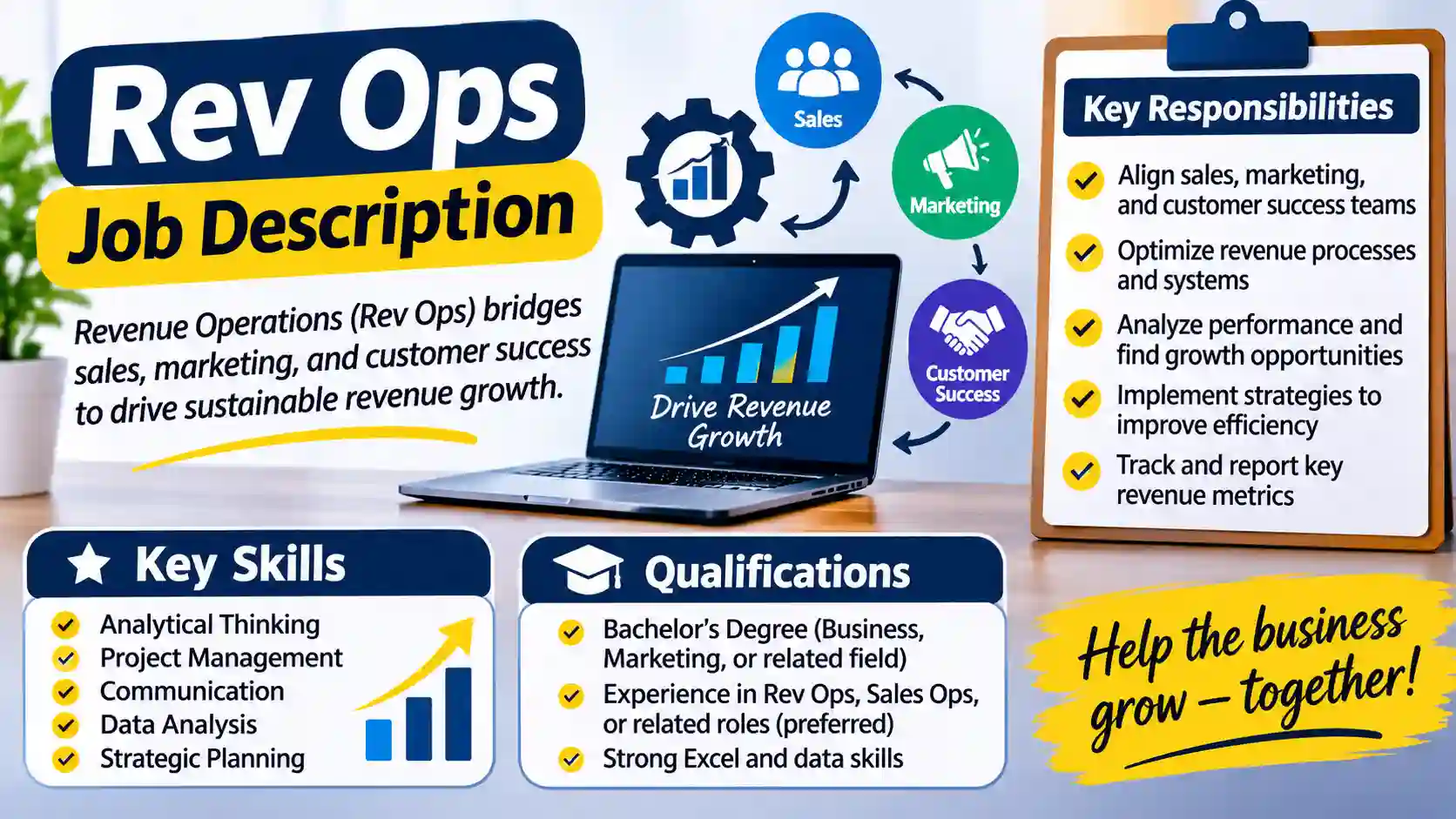
A RevOps Analyst plays an important role in helping businesses improve revenue performance. This professional works with marketing, sales, customer success, and finance teams to organize data, improve business processes, and support better decisions.
A RevOps Analyst job description explains the main duties, required skills, qualifications, and experience needed for this position. The role often includes managing customer relationship management (CRM) systems, preparing reports, analyzing sales performance, and supporting revenue forecasting.
Companies hire RevOps Analysts to improve communication between departments, reduce operational problems, and create a more organized revenue process. If you are interested in business operations, data analysis, and technology, this career may be a good option.
What Is a RevOps Analyst?
A RevOps Analyst, also known as a Revenue Operations Analyst, helps a company manage and improve the processes that generate revenue.

The role connects different departments, including:
- Marketing: Attracts potential customers through campaigns and promotional activities.
- Sales: Converts qualified leads into paying customers.
- Customer Success: Helps customers use products or services and encourages long-term relationships.
- Finance: Manages revenue reporting, payments, and financial information.
A RevOps Analyst studies information from these departments to understand business performance. They identify problems, prepare reports, maintain accurate data, and recommend improvements.
For example, if a company receives many marketing leads but only a small number become customers, a RevOps Analyst may examine lead quality, sales activity, and conversion rates to find the problem.
RevOps Analyst Job Description Template
Here is a sample job description that employers can use when hiring a Revenue Operations Analyst.
Job Title: Revenue Operations Analyst
Job Summary
We are looking for a detail-oriented Revenue Operations Analyst to support our marketing, sales, customer success, and finance teams. The successful candidate will analyze business data, maintain CRM systems, prepare performance reports, and identify opportunities to improve revenue operations.
The ideal candidate should have strong analytical skills, knowledge of business processes, and experience working with reporting tools and customer data.
Key Responsibilities
- Collect, organize, and analyze revenue-related data.
- Maintain accurate customer and sales information in CRM systems.
- Prepare reports and dashboards for business leaders.
- Monitor sales pipelines and conversion rates.
- Support revenue forecasting and business planning.
- Analyze marketing campaign performance.
- Identify problems in sales and marketing workflows.
- Improve data quality and reporting processes.
- Work with different departments to support shared revenue goals.
- Recommend ways to improve operational efficiency.
- Monitor important revenue performance metrics.
- Support automation and technology improvement projects.
Required Qualifications
- Bachelor’s degree in business administration, finance, marketing, economics, or a related field.
- Experience in data analysis, sales operations, business operations, or revenue operations.
- Knowledge of CRM platforms such as Salesforce or HubSpot.
- Strong spreadsheet and reporting skills.
- Good communication and problem-solving abilities.
- Understanding of sales and marketing processes.
- Ability to manage multiple tasks and meet deadlines.
RevOps Analyst Roles and Responsibilities
A RevOps Analyst performs several tasks that help a company improve its revenue processes. Daily responsibilities may differ depending on the business, but the main duties usually include the following.
1. Analyze Revenue Data
One of the main responsibilities of a RevOps Analyst is analyzing business data.

They review information from marketing, sales, and customer success departments to understand how the company is performing.
This may include:
- Sales revenue
- Lead generation
- Conversion rates
- Customer acquisition
- Customer retention
- Sales pipeline activity
- Marketing campaign results
By studying these numbers, analysts can identify trends and provide useful recommendations.
2. Manage CRM Systems
Customer Relationship Management (CRM) systems store information about leads, customers, sales activities, and business relationships.
A RevOps Analyst helps keep this information organized and accurate.
Common responsibilities include:
- Checking customer records.
- Removing duplicate information.
- Updating lead and account details.
- Monitoring sales activities.
- Supporting CRM reporting.
- Helping teams use the system correctly.
Accurate CRM data helps businesses make better decisions and improve customer communication.
3. Prepare Reports and Dashboards
Revenue Operations Analysts create reports that show how different departments are performing.
These reports may include sales revenue, lead conversion, pipeline value, customer retention, and campaign performance.
Dashboards help managers understand important information without reviewing large amounts of raw data.
4. Support Revenue Forecasting
Revenue forecasting helps businesses estimate how much money they may earn in the future.
A RevOps Analyst studies historical sales data, current opportunities, pipeline activity, and other business information to support these estimates.
Accurate forecasting helps management plan budgets, resources, and future business activities.
5. Improve Business Processes
A RevOps Analyst looks for problems that slow down business operations.
For example, leads may take too long to reach the sales team, or employees may repeat the same manual tasks.
The analyst studies these processes and recommends improvements that save time and reduce errors.
6. Support Marketing Operations
Marketing teams generate leads through advertisements, email campaigns, websites, and other promotional activities.

A RevOps Analyst helps measure marketing performance and understand which campaigns produce valuable leads.
They may also review lead quality, campaign results, and the handover process between marketing and sales.
7. Monitor Sales Performance
RevOps Analysts help sales teams understand their performance by tracking important activities and results.
They may monitor:
- Number of new leads.
- Sales opportunities.
- Deal conversion rates.
- Average deal size.
- Sales cycle length.
- Pipeline value.
- Monthly and quarterly revenue.
These reports help managers identify areas that need improvement.
8. Support Customer Success Operations
The role may also involve reviewing customer information after a sale.
RevOps Analysts help monitor customer adoption, renewals, satisfaction, and retention. This information helps companies understand customer needs and identify opportunities to improve long-term relationships.
What Skills Does a RevOps Analyst Need?
A successful RevOps Analyst needs technical knowledge, analytical abilities, and strong communication skills.
Technical Skills
Data Analysis: The ability to collect, organize, and understand business data.
CRM Management: Knowledge of CRM platforms and customer information management.
Excel and Spreadsheets: Experience using formulas, filters, pivot tables, and data organization features.
Reporting and Dashboards: The ability to prepare clear reports and present business information.
Business Intelligence: Understanding how data helps companies make decisions.
Workflow Automation: Basic knowledge of tools that reduce repetitive tasks.
Revenue Forecasting: Understanding how businesses estimate future revenue.
Soft Skills
- Communication
- Problem-solving
- Critical thinking
- Time management
- Teamwork
- Attention to detail
- Organization
- Adaptability
- Decision-making
These skills help analysts explain their findings and work effectively with different departments.
What Tools Does a RevOps Analyst Use?
Revenue Operations Analysts use different software platforms to manage customer information, analyze data, and improve business processes.
Salesforce
Salesforce is a CRM platform used to manage customer relationships, sales opportunities, and business information. RevOps Analysts may use it to monitor pipelines, maintain records, and prepare reports.
HubSpot
HubSpot provides tools for marketing, sales, customer service, and CRM management. Analysts can use HubSpot to review lead activity, track customer interactions, and monitor campaign performance.
Microsoft Excel
Excel is commonly used to organize information, analyze data, create spreadsheets, and prepare reports.
Google Sheets
Google Sheets allows teams to manage and share data online. It can support basic reporting and collaborative analysis.
Tableau
Tableau helps professionals create dashboards and visual reports. Analysts can use it to present business performance in an understandable format.
Power BI
Microsoft Power BI helps businesses analyze data and create interactive dashboards. It can combine information from different sources to support business reporting.
The tools used by a RevOps Analyst depend on the company’s technology, reporting needs, and business size.
What KPIs Does a RevOps Analyst Track?
Key Performance Indicators (KPIs) help businesses measure progress toward revenue and operational goals.

A RevOps Analyst may track the following metrics:
Customer Acquisition Cost (CAC)
CAC measures how much a business spends to acquire a new customer. It helps companies understand the cost of marketing and sales activities.
Annual Recurring Revenue (ARR)
ARR represents the annual value of recurring revenue from subscriptions or ongoing customer contracts.
Customer Lifetime Value (CLV)
CLV estimates how much revenue a business may earn from a customer throughout the entire customer relationship.
Customer Churn Rate
Churn rate measures the percentage of customers who stop using a company’s product or service during a specific period.
Conversion Rate
Conversion rate measures the percentage of leads or prospects who complete a desired action, such as making a purchase.
Sales Pipeline Value
This metric shows the total value of active sales opportunities. It helps teams understand potential future revenue.
Average Revenue per User (ARPU)
ARPU measures the average revenue generated by each user during a specific period.
Renewal Rate
Renewal rate measures the percentage of customers who continue their subscriptions or contracts.
Other metrics may include Total Contract Value (TCV), Days Sales Outstanding (DSO), customer satisfaction (CSAT), and revenue backlog.
RevOps Analyst Qualifications and Education
Many employers prefer candidates with a bachelor’s degree in a relevant field.
Common educational backgrounds include:
- Business Administration
- Finance
- Marketing
- Economics
- Accounting
- Information Systems
- Data Analytics
- Statistics
However, a specific degree is not always required. Some companies consider candidates with practical experience, technical skills, and relevant training.
Useful experience may include working in sales operations, marketing operations, business analysis, customer success, or data reporting.
Do You Need Experience to Become a RevOps Analyst?
Many entry-level RevOps positions accept candidates with limited professional experience, although requirements vary by employer.
People who are new to the field can prepare by learning:
- Basic business and revenue concepts.
- CRM platforms such as Salesforce or HubSpot.
- Excel and spreadsheet functions.
- Data analysis and reporting.
- Sales pipeline management.
- Marketing and customer success processes.
- Basic dashboard creation.
Building a small portfolio with sample reports, dashboards, and data analysis projects can also help demonstrate practical abilities.
RevOps Analyst Salary
A RevOps Analyst salary depends on several factors, including location, experience, company size, industry, and technical skills.

Entry-level analysts generally earn less than experienced professionals. Analysts with strong CRM knowledge, reporting experience, and data analysis skills may qualify for higher-paying opportunities.
When comparing salaries, candidates should consider:
- Country and city.
- Years of experience.
- Job responsibilities.
- Company size.
- Industry.
- Technical requirements.
- Benefits and additional compensation.
For accurate salary information, compare current job advertisements and salary reports for the same location and experience level.
RevOps Analyst Career Path
Revenue operations offers several opportunities for professional growth. An analyst can develop technical and leadership skills before moving into more senior roles.
A common career path includes:
1. RevOps Coordinator
A coordinator supports daily operations, maintains records, and helps different departments manage routine tasks.
2. RevOps Analyst
An analyst focuses on reporting, data analysis, CRM management, and business process improvement.
3. Senior RevOps Analyst
A senior analyst handles more complex projects, develops advanced reports, and provides recommendations to management.
4. RevOps Manager
A manager leads operational projects, develops strategies, and coordinates revenue-generating departments.
5. Director of Revenue Operations
A director oversees the broader RevOps function and ensures that business processes support company objectives.
6. Head of RevOps
The Head of RevOps leads the revenue operations department and works with senior leadership to improve business performance.
Some professionals may also move toward executive positions such as Chief Revenue Officer (CRO).
RevOps Analyst vs. Sales Operations Analyst
A RevOps Analyst and a Sales Operations Analyst both use data and business processes to improve performance. However, their areas of responsibility are different.
A Sales Operations Analyst mainly supports the sales department. Their work may include sales reporting, territory planning, pipeline management, and sales productivity.
A RevOps Analyst has a wider focus. They work across marketing, sales, customer success, and sometimes finance to improve the complete revenue process.
In simple terms, Sales Operations supports sales performance, while Revenue Operations connects the departments involved in generating and retaining revenue.
What Is a Typical Day for a RevOps Analyst?
The daily routine of a Revenue Operations Analyst depends on the company’s needs and team structure.
A typical workday may include:
- Reviewing CRM records and checking data accuracy.
- Monitoring sales pipeline activity.
- Preparing reports and dashboards.
- Analyzing marketing and sales performance.
- Meeting with department representatives.
- Reviewing conversion rates and revenue metrics.
- Finding problems in business workflows.
- Supporting automation and reporting projects.
- Sharing recommendations with managers.
Some days may focus mainly on data analysis, while others may involve meetings, system improvements, and business planning.
How to Become a RevOps Analyst
If you want to start a career in revenue operations, follow these steps.

Step 1: Learn Business Operations
Understand how marketing, sales, customer success, and finance contribute to company revenue.
Step 2: Develop Data Analysis Skills
Learn how to organize information, use spreadsheets, calculate business metrics, and identify trends.
Step 3: Learn CRM Platforms
Practice using CRM tools such as Salesforce and HubSpot. Understand how businesses manage leads, accounts, customer information, and sales opportunities.
Step 4: Improve Reporting Skills
Learn how to create reports and dashboards using spreadsheet and business intelligence tools.
Step 5: Understand Revenue Metrics
Study important KPIs such as CAC, ARR, CLV, conversion rate, churn rate, and sales pipeline value.
Step 6: Build Practical Projects
Create sample dashboards, sales reports, or customer data analysis projects. These can help demonstrate your abilities to employers.
Step 7: Apply for Entry-Level Roles
Search for positions such as RevOps Coordinator, Junior Revenue Operations Analyst, Sales Operations Analyst, or Business Operations Analyst.
RevOps Certifications and Training
Certifications can help candidates learn new tools and understand revenue operations processes.
Useful learning areas include:
- Salesforce CRM training.
- HubSpot Academy courses.
- Data analysis.
- Business intelligence.
- Microsoft Excel.
- Power BI.
- Sales operations.
- Revenue operations fundamentals.
Before choosing a certification, review its course content and check whether it matches the requirements of the jobs you want.
Challenges Faced by RevOps Analysts
Revenue Operations Analysts may face different challenges while managing business data and processes.
Inaccurate Data
Incorrect or outdated records can affect reports and business decisions. Analysts need to maintain data quality and identify information that needs correction.
Disconnected Systems
Companies may use separate platforms for marketing, sales, customer service, and finance. Connecting these systems can be difficult.
Poor Communication
Different departments may have different goals and reporting methods. Analysts help improve collaboration by creating shared reports and processes.
Manual Workflows
Repeated manual tasks can waste time and create errors. Analysts may recommend automation to improve efficiency.
Changing Business Needs
As a company grows, its technology, processes, and reporting requirements may change. RevOps Analysts need to adapt and help teams manage these changes.
Frequently Asked Questions
A RevOps Analyst studies business data, manages CRM information, prepares reports, monitors revenue performance, and helps improve processes across marketing, sales, and customer success.
A RevOps Analyst mainly focuses on data analysis, reporting, CRM management, and process improvement. A Revenue Operations Manager has broader responsibilities, including strategy, team coordination, and operational leadership.
It can be a good career for people interested in business operations, data analysis, technology, and problem-solving. The role can also provide opportunities to move into management and leadership positions.
Degrees in business administration, finance, marketing, economics, information systems, and data analytics can be useful. Employers may also consider relevant experience and technical skills.
Yes. Some entry-level positions accept candidates with limited experience. Learning CRM systems, Excel, reporting, and business operations can help you prepare.
Common tools include Salesforce, HubSpot, Microsoft Excel, Google Sheets, Tableau, and Power BI. The exact tools depend on the company.
Important skills include data analysis, CRM management, reporting, communication, problem-solving, spreadsheet knowledge, and understanding of revenue processes.
Common KPIs include customer acquisition cost, annual recurring revenue, customer lifetime value, churn rate, conversion rate, sales pipeline value, and renewal rate.
A common career path is RevOps Coordinator, RevOps Analyst, Senior RevOps Analyst, RevOps Manager, Director of Revenue Operations, and Head of RevOps.
Final Thoughts
A RevOps Analyst helps businesses improve revenue performance by connecting departments, analyzing data, managing CRM systems, and improving operational processes. The role requires a combination of technical knowledge, analytical thinking, and communication skills.

Ryan Mitchell writes job descriptions, role overviews and general description guides in plain, easy-to-follow language. He focuses on listing duties, skills and requirements clearly, so readers can understand a role or topic without wading through jargon.