

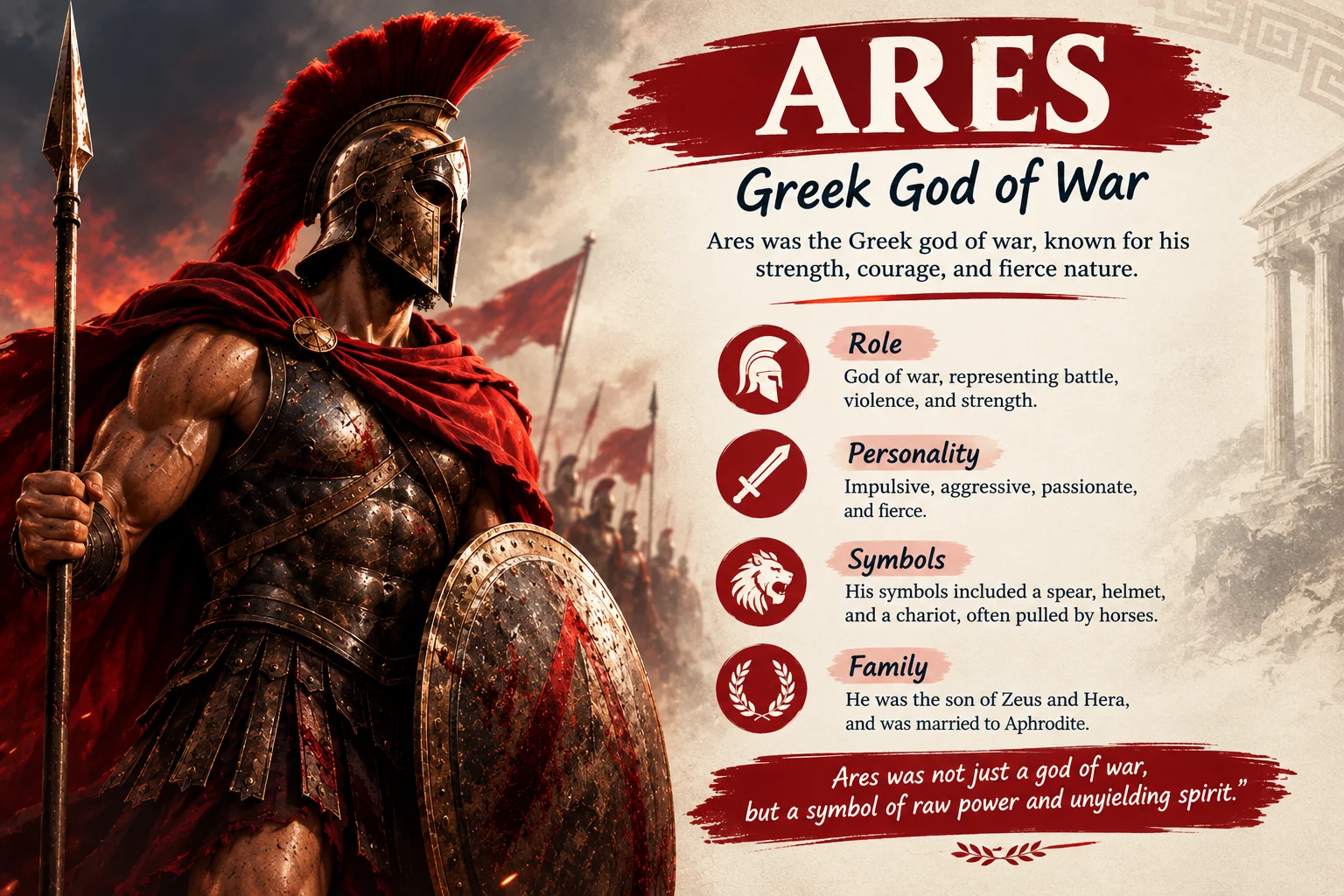
Ares is the Greek god of war, known for his strength, courage, anger, and love of battle. He is one of the twelve Olympian gods and the son of Zeus and Hera. In Greek mythology, Ares represents the violent and destructive side of war.
Unlike Athena, who represents wisdom and military strategy, Ares is often connected with bloodshed, fighting, and the chaos of battle. Although he is a powerful god, many Greek myths describe him as impulsive and difficult to control.
Ares also has important connections with Aphrodite, Hephaestus, Phobos, Deimos, and other figures in Greek mythology. His stories appear in famous legends, including the Trojan War and the tale of his imprisonment in a bronze jar.
This guide explains the complete description of Ares, including his physical appearance, personality, powers, symbols, family, famous myths, and role in ancient Greek religion.
Who Is Ares in Greek Mythology?
Ares is the Greek god of war and one of the major gods associated with Mount Olympus. He is the son of Zeus, the king of the gods, and Hera, the queen of the gods.
Ares represents the violent side of warfare. His name is connected with battle, destruction, anger, and the excitement of fighting. He is often shown entering battles with a spear, shield, helmet, and armor.
In Greek mythology, Ares is not always presented as a respected hero. Some stories portray him as brave and powerful, while others show him as reckless, emotional, and easily defeated.
The ancient Greeks viewed war as a complicated part of life. Ares represented its frightening and destructive side, while Athena represented careful planning, discipline, and military skill.

Ares Appearance Description
Ares is commonly described and portrayed as a strong, athletic, and muscular warrior. Ancient Greek artists often showed him as a young or mature man with a powerful body and the equipment of a soldier.
His appearance reflects his role as the god of war.
Common features associated with Ares include:
- Muscular body: His strong build represents physical power and fighting ability.
- Warrior helmet: A helmet protects his head and identifies him as a battle-ready god.
- Armor: He may wear armor similar to that of an ancient Greek warrior.
- Spear: The spear is one of his most recognizable weapons.
- Shield: A shield represents defense during battle.
- Sword: Some artistic depictions show Ares carrying a sword.
- Serious expression: Artists may portray him with an intense or aggressive look.
Ares does not have one fixed appearance in every ancient source. Greek sculptures, vase paintings, and later Roman artwork portray him in different ways.
Ares Physical Description
For a simple physical description, Ares can be imagined as a powerful warrior with a muscular build, strong arms, a determined face, and traditional Greek battle armor. He may carry a spear and shield and wear a helmet decorated in the style of an ancient soldier.
However, these details mainly come from artistic traditions rather than one complete description preserved in an ancient text.
Ares Symbols and Their Meanings
The symbols of Ares help explain his connection to warfare, danger, and military power.
1. Spear
The spear is one of the main weapons associated with Ares. It represents direct combat, attack, and the physical violence of war.
2. Helmet
A warrior’s helmet represents preparation for battle and the dangers faced by soldiers. It is a common feature in artistic representations of Ares.
3. Shield
The shield represents protection and defense during fighting. Together with the spear, it helps identify Ares as a warrior god.
4. Sword
The sword is another weapon associated with warfare and close combat. It represents the dangerous and personal nature of battle.
5. Dog
Dogs were associated with Ares in some ancient traditions. Their connection with the god reflects aggression, alertness, and the harsh nature of warfare.
6. Vulture
The vulture is another animal linked with Ares in some traditions. Because vultures are associated with battlefields and death, they fit the darker side of his character.
7. Boar
The boar appears in some traditions connected with Ares. It represents danger, aggression, and destructive force.
The symbols linked to Ares vary across ancient sources and artistic traditions. Not every symbol appeared in every depiction of the god.
Ares Personality: What Was the God of War Like?
Ares has a strong but complicated personality. He is often portrayed as aggressive, passionate, proud, and quick to anger.
Aggressive and Fearless
Ares is closely associated with fighting and direct confrontation. He is willing to enter dangerous battles and face powerful opponents.
His courage, however, can turn into recklessness. He often represents the desire to fight without fully considering the consequences.
Quick-Tempered
Ares is known for his anger. When challenged or insulted, he may respond with violence rather than patience or careful thought.
This trait separates him from gods who are more closely connected with wisdom and self-control.
Proud and Competitive
As the god of war, Ares has a strong sense of power and pride. He wants to prove his strength in battle and does not always accept defeat easily.
Passionate and Emotional
Ares is not only connected with fighting. His relationship with Aphrodite also shows his emotional and passionate side.
His stories include love, jealousy, conflict, and family disputes, making him more complex than a simple symbol of violence.
Powerful but Not Invincible
Ares is a god, but Greek mythology does not portray him as unbeatable. In the Iliad, Diomedes wounds him with Athena’s help. This episode shows that strength alone does not guarantee victory.
Ares Powers and Abilities
As the Greek god of war, Ares has powers connected with combat, physical strength, and the fear created by battle.
Control Over War and Battle
Ares is associated with the violence and confusion of warfare. His presence in a myth can represent the destructive force of a battlefield.
Superhuman Strength
Like other major Greek gods, Ares possesses divine strength. He can fight powerful opponents and take part in conflicts beyond the abilities of ordinary humans.
Combat Skills
Ares is a warrior who uses weapons and fights in battle. His traditional equipment includes a spear, shield, helmet, and armor.
Ability to Inspire Fear
Ares is linked with fear and terror through his sons Phobos and Deimos. These figures personify the fear and panic associated with war.
Divine Durability
As an Olympian god, Ares is not an ordinary mortal. However, myths can still show him being wounded, defeated, or humiliated.
Association With Warriors
Ares is connected with soldiers, combat, and the experience of fighting. His role focuses more on the violent energy of war than on the planning and discipline represented by Athena.
Ares Family Tree
Ares belongs to the family of Olympian gods. His relatives connect him to many major stories in Greek mythology.
Parents of Ares
Zeus: Zeus is the king of the Greek gods and the father of Ares.
Hera: Hera is the queen of the gods and the mother of Ares in the usual Greek tradition.
Siblings of Ares
Ares’s siblings include several important divine figures, although family relationships vary between ancient sources.
- Athena: The goddess of wisdom and strategic warfare.
- Hephaestus: The god of fire, metalworking, and craftsmanship.
- Hebe: The goddess associated with youth.
- Eileithyia: The goddess associated with childbirth.
Apollo, Artemis, Hermes, Dionysus, and other gods are also connected to Ares through the wider family of Zeus, though their exact relationships differ according to the tradition.
Children of Ares
Ares has several children in Greek mythology. Their identities and parentage vary between sources.
- Phobos: The personification of fear.
- Deimos: The personification of terror.
- Harmonia: A goddess associated with harmony.
- Eros: In some traditions, Eros is connected with Ares and Aphrodite.
- Anteros: A figure associated with reciprocal love in traditions linking him to Aphrodite.
Ares is also connected with other mythological figures, including Alcippe, whose story leads to the trial associated with the Areopagus in Athens.
Ares and Aphrodite: The Love Story
Ares and Aphrodite are among the most famous couples in Greek mythology. Aphrodite is the goddess of love and beauty, while Ares represents war and conflict.
Their relationship brings together two very different forces: love and violence.
In a well-known story told in Homer’s Odyssey, Aphrodite and Ares become lovers while Aphrodite is married to Hephaestus. Hephaestus discovers their relationship and creates a nearly invisible bronze net to trap them together.
He then exposes them to the other gods. The story is often remembered for its humor, embarrassment, and conflict among the Olympians.
Ares and Aphrodite are associated with several children in different traditions, including Phobos, Deimos, and Harmonia. Their relationship is an important part of Ares’s character because it shows his emotional life beyond warfare.
Ares vs Athena: What Is the Difference?
Ares and Athena are both connected with war, but they represent different sides of it.
| Ares | Athena |
| God of war and battlefield violence | Goddess of wisdom and strategic warfare |
| Represents aggression and bloodshed | Represents planning and discipline |
| Associated with direct combat | Associated with intelligent military decisions |
| Often acts impulsively | Often acts thoughtfully |
| Connected with fear and terror | Connected with wisdom and skill |
The contrast between Ares and Athena appears in Greek stories, especially the Iliad. Their differences show that the ancient Greeks understood warfare as more than physical strength. Planning, discipline, and intelligence also mattered.

Ares and Mars: Greek and Roman Names
Ares is the Greek god of war, while Mars is his Roman counterpart. The two gods share a connection with warfare, but their cultural roles are not identical.
In Greek mythology, Ares is often presented as a violent and unpredictable figure. Roman religion gave Mars a more prominent place in the state and military traditions of Rome. He was associated not only with war but also with Rome’s legendary origins and protection.
The Greek and Roman gods share similarities, but they developed within different religious and cultural traditions. For this reason, Ares and Mars should not be treated as completely identical in every detail.
Athena is often compared with the Roman goddess Minerva, who shares many of her associations with wisdom and skilled activity.
Famous Ares Stories in Greek Mythology
Ares appears in several well-known myths that reveal his strengths, weaknesses, and relationships with other gods.
Ares in the Trojan War
The Trojan War is one of the most famous stories in Greek mythology. It is described in Homer’s Iliad, which follows part of the conflict between the Greeks and the Trojans.
Ares supports the Trojans in parts of the story, while Athena supports the Greek side. The gods become involved in the fighting and sometimes face one another directly.
During the war, Diomedes attacks Ares with Athena’s assistance and wounds the god. Ares leaves the battlefield and complains to Zeus.
This episode shows that Ares, despite his divine power, can suffer defeat. It also highlights the difference between his aggressive approach and Athena’s strategic assistance.
The Capture of Ares by the Aloadae
In another myth, the giant brothers Otus and Ephialtes, known as the Aloadae, capture Ares and imprison him in a bronze jar.
Ares remains trapped for a long period until Hermes helps free him. The story is unusual because it shows a powerful Olympian god unable to escape without assistance.
The myth also reminds readers that Greek gods could face danger, humiliation, and unexpected challenges.
The Trial of Ares at the Areopagus
Ares is connected with the Areopagus, a rocky hill in Athens that became famous as a place of judgment.
According to a myth, Ares kills Halirrhothius, a son of Poseidon, after an incident involving Alcippe, Ares’s daughter. Poseidon brings the matter before a divine court, and Ares is tried for the killing.
The story provides a mythological explanation for the name of the Areopagus, which is traditionally linked with Ares. The site later became associated with legal and judicial traditions in Athens.
Ares and Heracles
Ares is also linked to stories about Heracles, the famous Greek hero known for his strength and twelve labors.
One tradition tells of a conflict involving Heracles and Cycnus, a son of Ares. Ares becomes involved in the fight and confronts Heracles, but the hero receives divine assistance and survives the encounter.
The details differ across ancient accounts, but the story connects Ares with heroic combat and the challenges faced by Greek heroes.
Ares and the Golden Fleece
The Golden Fleece appears in the story of Jason and the Argonauts. It is kept in a sacred grove associated with Ares in Colchis and guarded by a dragon.
Jason’s quest to obtain the fleece is one of the best-known adventures in Greek mythology. Although Ares is not the central character in the story, the sacred grove links him to this famous legend.
Ares in Ancient Greek Religion
Ares was worshipped in parts of the ancient Greek world, although his importance varied by region. His connection with war made him relevant to soldiers and communities concerned with conflict and protection.
Ancient traditions associate Ares with Thrace, a region north of Greece, and with places such as Sparta and Athens. However, worship practices were not the same everywhere.
Ares is also connected with the Athenian Agora, where a temple associated with the god was located. Religious sites, inscriptions, and artistic objects help researchers understand how ancient Greeks viewed him.
Ares was not simply a character in stories. He belonged to a wider religious world in which people made offerings to gods, held festivals, and sought divine help during difficult times.
Ares in Ancient Art
Ancient Greek and Roman artists represented Ares through sculptures, pottery, and other artworks. These images often show him as an armed warrior.
Some artistic representations emphasize his youth and physical beauty, while others focus on his helmet, armor, and weapons. Later Roman images of Mars also influenced how audiences imagined the god of war.
One famous sculpture traditionally associated with Ares is known as the Ares Borghese. It reflects the artistic interest in depicting gods as idealized human figures.
Ancient artwork does not always provide a complete description of a god’s personality. However, it helps explain the symbols and physical features associated with Ares.

Ares in Percy Jackson
Ares also appears in modern stories inspired by Greek mythology, including Rick Riordan’s Percy Jackson and the Olympians series.
In the series, Ares is portrayed as an aggressive and intimidating god who enjoys conflict. His modern characterization draws on the traditional Greek image of a god associated with fighting and violence.
Readers may also encounter references to Ares’s children and his cabin at Camp Half-Blood. These details belong to the fictional world of Percy Jackson and should be distinguished from ancient Greek religious traditions.
The Percy Jackson books introduce Greek mythology to modern readers, but their characters and events sometimes differ from ancient sources.
Frequently Asked Questions
Ares is the Greek god of war, particularly its violent and destructive side. He is associated with fighting, bloodshed, aggression, and battlefield conflict.
Ares is commonly portrayed as a muscular warrior wearing a helmet and armor and carrying a spear or shield. His exact appearance varies across ancient artwork and later interpretations.
Ares is associated with a spear, shield, helmet, sword, and war chariot. Dogs, vultures, and boars are also connected with him in some traditions.
Ares is often described as aggressive, proud, passionate, quick-tempered, and impulsive. He is powerful but is not always shown as wise or disciplined.
Ares is usually described as the son of Zeus and Hera, two of the most important gods in Greek mythology.
Ares is most famously associated with Aphrodite, the goddess of love and beauty. Their relationship is central to several Greek myths, but ancient traditions differ about their formal marital status.
Phobos, Deimos, and Harmonia are among the children associated with Ares in Greek mythology. Other children appear in different traditions.
The Roman counterpart of Ares is Mars. Although the gods share a connection with war, their roles in Greek and Roman religion are not exactly the same.
Ares is not simply a villain. He is a complex mythological god who represents the destructive side of war. Some stories show his power and courage, while others emphasize his anger, recklessness, and defeats.
Yes. Ares is commonly included among the Twelve Olympians, the major Greek gods associated with Mount Olympus.
Final Thoughts
Ares is one of the most recognizable gods in Greek mythology because he represents the violence, fear, and intensity of war. As the son of Zeus and Hera, he belongs to the Olympian family and is connected with gods such as Athena, Aphrodite, and Hephaestus.
His muscular warrior appearance, spear, shield, and helmet make him easy to recognize in ancient art. His stories, including the Trojan War, the bronze jar imprisonment, and the trial at the Areopagus, show both his power and his weaknesses.
Understanding Ares alongside other Greek gods provides a clearer picture of ancient Greek mythology. His contrast with Athena, his relationship with Aphrodite, and his Roman counterpart Mars reveal how different cultures understood warfare, courage, and divine power.

Ryan Mitchell writes job descriptions, role overviews and general description guides in plain, easy-to-follow language. He focuses on listing duties, skills and requirements clearly, so readers can understand a role or topic without wading through jargon.