

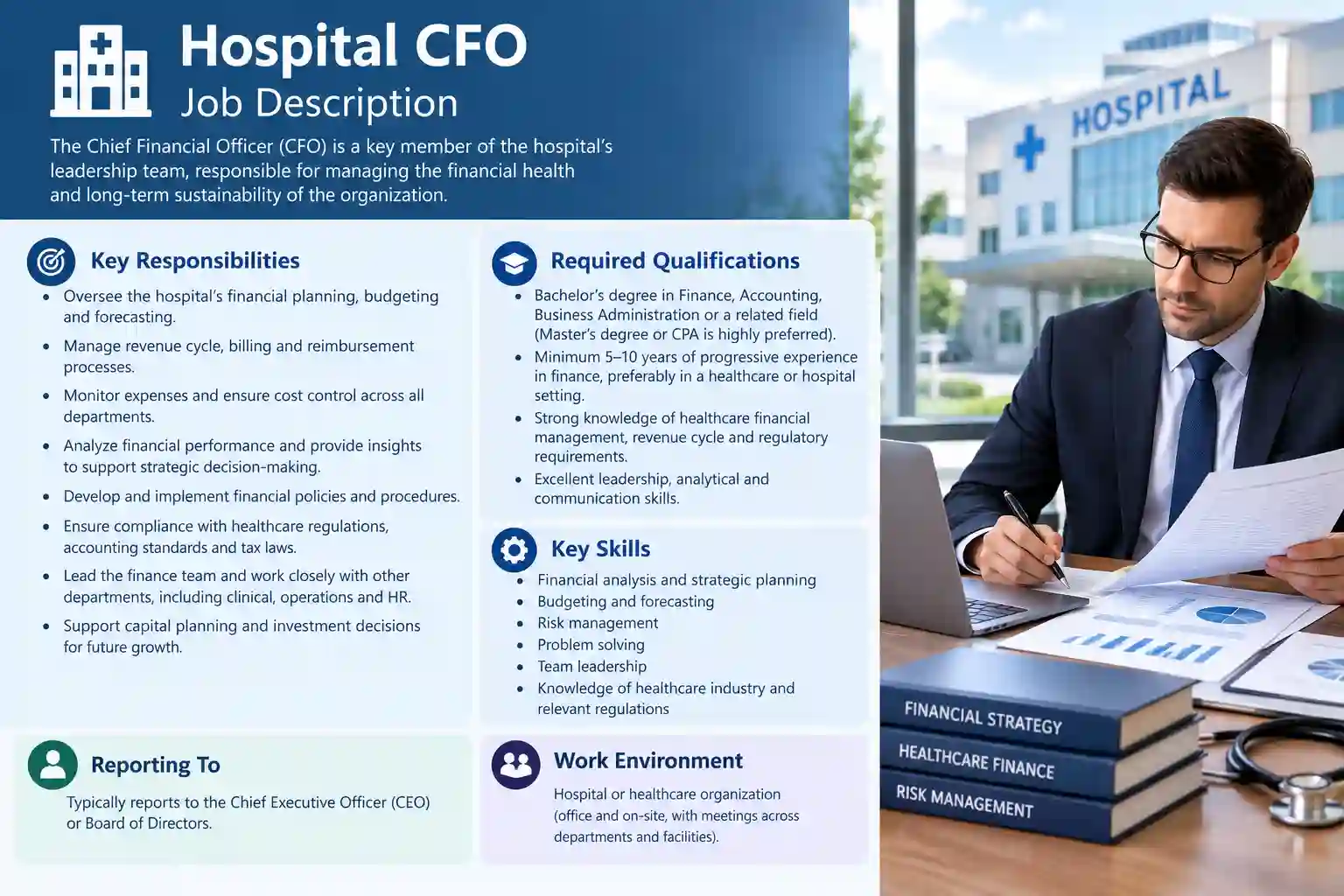
A hospital runs on two things at once: patient care and money. When finances falter, care suffers. The person who keeps both in balance is the Chief Financial Officer. This guide gives a complete hospital CFO job description, covering the role, duties, skills, qualifications, salary, a PDF-ready template, and tips for writing a hospital CFO job description for a resume. It also explains the role in Pakistan, how it differs from related positions, which KPIs a hospital CFO tracks, how to hire one, and how to prepare for the interview.
What Is a Hospital CFO?
If you are wondering what a CFO of a hospital is, the answer is simple. A hospital CFO, or Chief Financial Officer, is the senior executive responsible for all financial activities of a hospital or health system. The CFO leads the finance department, protects the hospital’s financial stability, and makes sure the organization can keep serving patients today while investing in growth tomorrow.
The CFO usually reports to the hospital CEO and works closely with the Board of Directors, Board of Trustees or Board of Governors, depending on how the hospital is structured. The CFO also coordinates with department heads and clinical leaders, and often sits on the executive team that shapes long-term strategy. The role exists in acute-care hospitals, specialty care centers, clinics, and large hospital systems, whether they are investor-owned, non-profit, or government-run.
A hospital CFO is not the same as a CFO in the hospitality industry. A CFO hospitality job description focuses on hotels, restaurants, and travel businesses, while a hospital CFO deals with patient billing, insurance reimbursement, and healthcare regulation.

Hospital CFO Job Summary
The Hospital CFO provides leadership and direction to all financial departments and carries overall fiscal responsibility for the hospital. The role covers financial strategy, policies, procedures, and the internal controls framework that keeps the organization stable. The CFO leads accounting and the general ledger, financial, management and regulatory reporting, forecasting and budgeting, accounts payable and receivable, audits, taxation, finance systems, grants and funds management, and treasury. The CFO also advises the CEO, the Board, and department heads on finance and accounting matters.
Key Responsibilities of a Hospital CFO
The general CFO job description is similar across industries, but hospital CFO responsibilities have a healthcare focus. Here are the main hospital CFO duties.
Financial Strategy and Planning
The CFO prepares and implements the hospital’s financial strategy and policies to achieve institutional financial objectives. This includes helping the CEO build long and short-range operating plans, which may involve service demand analysis, resource availability analysis, and cost-benefit analysis of proposed capital investments and staff expansion. The CFO also evaluates the financial impact of new programs, acquisitions, and business development opportunities.
Budgeting and Forecasting
The CFO develops long and short-range operating and capital budgets that match the hospital’s plans and goals. Department managers receive support in building their own budgets, and the CFO recommends changes when conditions shift. Throughout the year, the CFO prepares cash flow analyses and budget variance analyses to compare actual results with the plan.
Financial Reporting and Analysis
The CFO oversees accurate, timely financial statements, internal reports, and statistical reports. These keep the CEO, the Board, and other stakeholders informed about hospital performance. The CFO also monitors results against plans, flags undesirable trends early, and points out new business opportunities with recommendations for action.
Revenue Cycle and Patient Financial Services
Hospital revenue is complex. It comes from patient billing, insurance claims, third-party reimbursement, government programs, and other sources. The CFO oversees patient business services, from admissions and registration to billing, receivables management, and collections. This also includes reimbursement strategies, reports, and appeals, all aimed at fewer claim denials, faster payment, and healthier cash flow.
Cost Control and Operational Efficiency
The CFO takes a lead role in reducing operating costs and increasing revenue, using knowledge of market trends, financial reports, and operating procedures. This may involve renegotiating supplier contracts, tightening materials management, or streamlining workflows across departments, all without hurting the quality of patient care.
Regulatory Compliance, Taxation and Audit
Healthcare is one of the most regulated industries, and the CFO makes sure the hospital follows financial regulations and accounting standards. The CFO directs the submission of required reports to government and regulatory agencies, including payroll tax reports, public disclosure reports, and third-party payor cost reports. The CFO also oversees tax returns and tax planning, prepares audit work papers, finalizes annual financial statements, works with external auditors, and presents the audited statements to the Board for approval. Where the hospital has loans or grants, the CFO also ensures compliance with the covenants and conditions set by banks, government bodies, and funders.
Risk Management, Treasury and Funding
The CFO manages financial risk, including liquidity, credit, insurance, and investment risk. This covers banking relationships, debt management, disbursements such as payroll and accounts payable, and the oversight of funding, repayments, and grants. In some institutions, the CFO also approves payments above a set threshold, the payroll summary, and the chart of accounts.
Systems, Data and Technology
The CFO ensures that the hospital uses sound accounting systems and reliable financial information. In many hospitals, the finance leader also provides direction on data processing, distributed systems, materials management, and even medical records functions, so data flows accurately between clinical and financial teams.
Contracts and Stakeholder Communication
The CFO negotiates commercial agreements with suppliers, insurers, and lenders, and maintains strong relationships with banks, government bodies, related entities, and funding partners. Clear communication matters just as much. The CFO explains financial results and risks in plain language to the CEO, the Board, clinicians, lenders, and regulators. In investor-owned hospitals, the CFO also keeps investors informed about performance and funding needs. In larger institutions, the CFO may act as secretary to the Finance and Audit Committee and represent the hospital before government committees.
Team Leadership and Culture
The CFO plans, assigns, and reviews the work of the finance team, hires and trains staff, and tracks performance so fiscal responsibilities are met. Building a culture of accountability and merit, supported by clear performance management, is part of the job.

Strategic CFO Job Description
Modern hospitals increasingly look for a strategic CFO, not just a financial controller. A strategic CFO job description goes beyond reporting and compliance. In this version of the role, the CFO:
- Acts as a strategic partner to the CEO and Board in shaping the hospital’s direction
- Uses financial data to guide decisions on new services, expansion, and partnerships
- Connects capital investment with clinical priorities and patient outcomes
- Builds long-term financial models and scenario plans for changing reimbursement and regulation
- Drives performance improvement across departments, not only within finance
- Uses technology and analytics to turn financial information into insight
Hospitals that want this profile often write “strategic” into the job title or summary, and look for candidates who have led transformation or growth projects.
Key Financial Metrics and KPIs a Hospital CFO Tracks
A hospital CFO relies on financial and operational indicators to judge performance and spot problems early:
- Operating margin and total margin: Show whether the hospital earns more than it spends.
- Days in accounts receivable: Measures how quickly the hospital collects what it is owed.
- Claim denial rate: The share of insurance claims rejected, which signals billing and documentation problems.
- Net collection rate: How much of the collectible revenue the hospital actually receives.
- Days cash on hand: Shows how long the hospital can operate without new income.
- Cost per patient day or per case: Helps compare efficiency across departments.
- Labor cost as a percentage of revenue: Staffing is usually the largest expense in a hospital.
- Supply expense per case: Tracks spending on medical supplies and materials.
- Budget variance: The gap between planned and actual results.
- Bed occupancy and average length of stay: Operational figures that directly affect revenue.
Hospital Revenue Cycle Management
The revenue cycle is the full path of a patient account, from registration and insurance verification to billing, claim submission, payment posting, and collections. Weak spots anywhere along that path create delays and lost income. A hospital CFO usually focuses on:
- Accurate patient registration and insurance verification at the front end
- Clean documentation and coding so claims are not rejected
- Fast claim submission and active follow-up on unpaid or denied claims, including third-party payor claims
- Clear patient billing and payment options
- Regular reporting on denials, delays, and write-offs
Even small improvements in the revenue cycle can have a large effect on cash flow, which is why it sits high on every hospital CFO’s priority list.
How the Hospital CFO Builds the Budget
Budgeting in a hospital is a team effort led by the CFO. A typical process looks like this:
- Review last year’s results and current performance.
- Agree on strategic priorities with the CEO and Board.
- Forecast patient volumes, service demand, and revenue.
- Collect departmental budget requests and challenge them against priorities.
- Prepare operating and capital budgets, including cash flow projections.
- Get approval from senior management and the Board.
- Track results monthly and adjust where needed.
Skills Required for a Hospital CFO
A successful hospital CFO combines technical financial expertise with leadership and healthcare knowledge.
- Financial and accounting expertise: Deep knowledge of generally accepted accounting principles, financial analysis, and corporate finance.
- Healthcare industry knowledge: Understanding of reimbursement models, payer contracts, patient billing, and healthcare regulations.
- Strategic thinking: The ability to connect financial decisions with the hospital’s long-term goals.
- Leadership and coaching: Skill in guiding teams, motivating staff, and keeping employee satisfaction high while delivering results.
- Communication: The ability to explain complex financial information clearly in reports, correspondence, and presentations to managers, the Board, investors, and the public.
- Analytical and reasoning ability: Strength in defining problems, collecting data, establishing facts, and drawing valid conclusions.
- Quantitative skills: Comfort with percentages, ratios, proportions, probability, and statistical inference.
- Technology proficiency: Familiarity with MS Office, ERP and financial management software such as Oracle or SAP, and hospital information systems.
- Negotiation: Useful for dealing with insurers, suppliers, lenders, and partners.
- Ethics and integrity: Handling hospital funds demands the highest standards of honesty and accountability.
- Planning and initiative: Organizing priorities and driving change when the financial picture shifts.
Qualifications and Experience
Requirements vary by country and by hospital, but most employers look for the following:
- A bachelor’s degree in accounting, finance, or business administration. A master’s degree, such as an MBA or a master’s in finance or healthcare administration, is often preferred.
- A professional credential such as CPA, CA, ACCA, or CMA. CPA is most common in the United States and Canada, while CA and ACCA are widely recognized in the United Kingdom, Pakistan, and many other countries.
- Around 10 to 12 or more years of overall experience, including several years in a senior role. Some hospitals specifically want at least three years at CFO level in an acute-care hospital, or progressive management experience in an investor-owned healthcare organization.
- Strong exposure to the health sector, which many employers treat as a major advantage.
Hospital CFO Job Description in Pakistan
In Pakistan, the job description of a CFO in a hospital follows the same core structure, with local professional bodies and regulations shaping the requirements. A typical hospital CFO job description in Pakistan includes:
- Reporting line: The CFO usually reports to the Chief Executive Officer and supports the Board of Governors or Board of Directors.
- Core duties: Preparing and implementing financial strategy, policies and controls, leading accounting, taxation, budgeting, audit, treasury, and finance systems, and ensuring compliance with applicable rules and regulations.
- Healthcare-specific duties: Managing reimbursement strategies and appeals, operating and capital budgets, patient financial services, receivables management, and the financial analysis of new programs and business development.
- Funding and stakeholders: Coordinating grants and funding, working with government bodies, and negotiating contracts with third parties.
- Education: Commonly a Chartered Accountant (ICAP), a cost and management accountant (ICMAP), a member of a recognized foreign accountancy body, or a master’s degree in finance. Training at a Big Four firm is often seen as a plus.
- Experience: Typically 12 or more years of total experience with at least five years at a senior level, along with proficiency in MS Office and ERP software such as Oracle or SAP.
- Location: Roles are commonly based in major cities such as Islamabad, Lahore, and Karachi.
Government and public-sector hospitals and health institutes add further duties. The CFO may manage Public Sector Development Programme (PSDP) budgets and projects, help each institute or center with budget, expenditure, and revenue, and represent the institution before bodies such as the Public Accounts Committee (PAC), the Departmental Accounts Committee (DAC), and the Departmental Development Working Party (DDWP).
ICAP vs ACCA vs ICMAP for Hospital Finance Careers
ICAP (Chartered Accountant) is widely seen as the most recognized route for senior finance roles in Pakistan and is often listed first in job descriptions. ACCA is globally recognized and accepted by many private and international healthcare organizations. ICMAP (cost and management accountant) is valued for costing, budgeting, and performance management, which are central to hospital finance. Whichever you choose, pairing it with healthcare experience matters more to hospital employers than the credential alone.
Hospital CFO vs Other Finance and Leadership Roles
Hospital CFO vs Hospital CEO: The CEO leads the whole hospital, including clinical, operational, and strategic direction. The CFO focuses on financial strategy and control, and supports the CEO with analysis and recommendations.
Hospital CFO vs Finance Director vs Controller: The CFO is the top finance executive and a member of the senior leadership team. A finance director often sits one level below, managing finance operations. The controller focuses on accounting, financial statements, internal controls, and audit preparation.
Assistant or Deputy CFO: This role supports the CFO in planning, reporting, and team management, and is often being prepared to step into the top job.
Hospital Finance Manager: This role handles day-to-day operations such as accounts payable and receivable, payroll processing, reconciliations, and monthly reporting, while the CFO sets strategy and carries overall accountability.
Hospital CFO vs Healthcare CFO: A hospital CFO focuses on a single hospital or hospital system, while a healthcare CFO may work across clinics, insurers, pharmaceutical companies, or other healthcare organizations.

Hospital CFO Job Description PDF and Template
Many employers and candidates look for a hospital CFO job description PDF or a CFO roles and responsibilities PDF they can edit. Copy the template below into a Word document and save it as a PDF for your hiring process. It works for interim CFO roles too, and can be tailored to a general hospital, a specialty care center, or a clinic network.
Job Title: Chief Financial Officer (CFO), Hospital
Reports To: Chief Executive Officer
Department: Finance
Position Summary:
The Chief Financial Officer provides leadership and direction to all financial departments and is responsible for the overall fiscal management of the hospital. The CFO develops financial strategy, ensures compliance, and supports the CEO and Board in achieving the hospital’s mission.
Key Responsibilities:
- Develop and implement financial strategy, policies, and internal controls.
- Lead long and short-range planning, including operating and capital budgets.
- Prepare cash flow and budget variance analyses and report on financial performance.
- Oversee accurate and timely financial, management, and regulatory reporting.
- Manage the revenue cycle, including patient business services, third-party reimbursement, billing, and collections.
- Monitor costs, identify savings, and grow revenue opportunities.
- Ensure compliance with tax, regulatory, and audit requirements, including required government reports.
- Manage treasury, banking, funding, investments, and financial risk.
- Negotiate contracts with suppliers, payers, and lenders.
- Communicate financial performance clearly to the CEO, Board, investors, and other stakeholders.
- Lead, train, and develop the finance team.
- Advise the CEO, Board, and department heads on financial matters.
Qualifications:
- Bachelor’s degree in accounting or finance; CPA, CA, ACCA, or master’s degree strongly preferred.
- 10+ years of finance experience, including senior leadership in a hospital or healthcare organization.
- Strong knowledge of healthcare reimbursement, regulation, and financial software.
- Excellent leadership, communication, analytical, and negotiation skills.
How to Hire a Hospital CFO
Hiring a CFO is one of the most important decisions a hospital board or CEO will make. A simple checklist helps:
- Define the need. Decide whether you need a hands-on operator, a strategic partner, or a turnaround leader.
- Write a clear job description. Use the template above and adjust it to your hospital’s size, ownership, and goals.
- Set realistic requirements. Balance credentials, years of experience, and healthcare exposure.
- Search widely. Use career pages, professional bodies, networks, and healthcare executive search firms. Many hospitals use retained executive search for senior roles like this one.
- Assess beyond the resume. Look at leadership style, communication, ethics, and cultural fit alongside technical skill.
- Check references thoroughly. Speak to former CEOs, board members, and auditors.
- Plan the first 90 days. Agree on priorities such as reviewing the budget, the revenue cycle, and internal controls.
Interim CFO for Hospitals
Some hospitals bring in an interim CFO when a CFO leaves suddenly, when a turnaround is needed, or during a merger, system upgrade, or audit problem. An interim CFO provides experienced leadership for a limited time while the hospital searches for a permanent hire. The same job description can be used, with the scope and timeline adjusted.
Hospital CFO Job Description for a Resume
If you are applying for hospital CFO jobs, a strong hospital CFO job description for a resume highlights achievements, not just duties. For example:
- Led financial strategy for a multi-department hospital, improving operating margin through cost optimization.
- Oversaw the revenue cycle, reducing claim denials and shortening collection times.
- Managed operating and capital budgets and delivered accurate reporting to the Board.
- Directed a finance team and strengthened internal controls ahead of external audits.
- Negotiated payer and supplier contracts that improved cash flow.
Use numbers wherever you can, such as percentages saved, revenue increased, or days reduced in accounts receivable. Mention your credentials and software experience clearly, since hiring committees scan for them first. A short cover letter that connects your experience to the hospital’s specific financial challenges can also set you apart.
Hospital CFO Interview Questions
If you are preparing for a hospital CFO interview, expect questions like these:
- How would you improve our hospital’s cash flow and reduce days in accounts receivable?
- How do you balance cost control with quality of patient care?
- Describe your experience with reimbursement, payer negotiations, and denial management.
- How do you build and present a budget to the Board?
- Tell us about a time you handled a major audit finding or compliance issue.
- How do you communicate financial results to clinical leaders who are not finance experts?
- What financial metrics do you review every month, and why?
- How would you prioritize capital investments when funds are limited?
- How do you build and lead a strong finance team?
Strong answers use real examples with numbers and show an understanding of both finance and patient care.
Hospital CFO Working Conditions
Hospital CFOs mostly work in an office environment with a moderate noise level, though they regularly meet clinical and operational teams across the facility. The work involves a lot of sitting, with occasional standing and walking, and sometimes lifting light items. Hours can run long during budget season, audits, and year-end closing. Travel may be needed for board meetings, conferences, or visits to affiliated facilities.
Full-time hospital CFO roles often come with a benefits package. In the United States this may include a 401(k) with employer matching, health, dental, and vision insurance, a health savings account, life insurance, an employee assistance program, paid time off, and in some cases performance bonuses. Reputable employers also state that they are equal opportunity employers and make reasonable accommodations for people with disabilities.
Hospital CFO Salary

Many readers search for the hospital CFO job description and salary together, because pay is one of the first things candidates and employers want to know. Hospital CFO salary varies widely with the country, the hospital’s size, whether it is public or private, and the CFO’s experience. Large hospital systems generally pay more than small community hospitals, and many positions include bonuses tied to financial performance.
Chief financial officer salary in general also depends on the industry, company size, and location, and hospital CFOs are usually compared with CFOs in other healthcare and non-profit organizations. Pay differs between the United States, the United Kingdom, Canada, and Pakistan, and within Pakistan it differs noticeably between government, private, and international hospitals. For accurate figures, check a current salary guide for your country, or compare recent hospital CFO job postings from similar hospitals.
Hospital CFO Jobs: Where to Look
If you are searching for hospital CFO jobs, check these sources:
- Hospital and health system career pages
- Professional accountancy job boards
- Executive search firms that specialize in healthcare
- Social media pages of hiring hospitals, where urgent CFO vacancies are often announced
- Professional networking platforms
How to Become a Hospital CFO
- Earn a degree in accounting, finance, or a related field.
- Gain a professional certification such as CPA, CA, ICAP, or ACCA.
- Start in an entry-level finance role, such as staff accountant or financial analyst, ideally in a healthcare setting.
- Move into management, for example as finance manager, controller, or director of finance.
- Build healthcare-specific expertise in revenue cycle, reimbursement, and compliance.
- Take on executive responsibility, such as vice president of finance, before stepping into the CFO role.
Many professionals also add an MBA or a healthcare finance credential along the way.
Challenges Hospital CFOs Face
The role comes with real pressure. Rising supply and labor costs, changing reimbursement models, regulatory shifts, and the need to invest in new technology all compete for limited funds. A strong CFO balances these demands while protecting the quality of patient care.
Hospital Cost Reduction Strategies
CFOs often lead cost reduction without cutting quality. Common approaches include renegotiating supplier and vendor contracts, standardizing medical supplies, improving staff scheduling, reducing waste and duplicate tests, upgrading billing systems to cut denials, and using data to find departments with unusually high costs.
Healthcare Financial Compliance Checklist
A simple compliance routine for a hospital finance team includes:
- Keeping accurate, up-to-date accounting records
- Filing tax and payroll reports on time
- Submitting required government and payer cost reports
- Maintaining documented internal controls and approval limits
- Preparing for external audits throughout the year, not only at year-end
- Reviewing loan and grant conditions regularly
- Training finance staff on policy and regulatory changes

Frequently Asked Questions
A hospital CFO manages the hospital’s finances, including budgeting, financial reporting, revenue cycle, compliance, and strategic financial planning.
The main responsibilities include financial strategy, budgeting and forecasting, financial reporting, revenue cycle oversight, cost control, regulatory compliance, risk management, stakeholder communication, and finance team leadership.
Most hospitals require a degree in accounting or finance, a professional credential such as CPA, CA, ICAP, or ACCA, and roughly 10 or more years of experience, ideally in healthcare.
A hospital CFO usually reports to the hospital CEO and works closely with the Board.
It covers financial strategy, accounting, taxation, budgeting, audit, treasury, reimbursement, patient financial services, and stakeholder coordination, usually with ICAP, ICMAP, or equivalent qualifications and 12 or more years of experience. Public-sector roles may also involve PSDP budgets and government committees.
Yes. You can copy the template in this article into a document, edit it to match your hospital, and save it as a PDF.
Common KPIs include operating margin, days in accounts receivable, claim denial rate, net collection rate, days cash on hand, cost per patient day, labor cost ratio, and budget variance.
The titles are sometimes used interchangeably, but a CFO is generally the top finance executive and a member of the senior leadership team, while a finance director may sit one level below.
A hospital CFO works in healthcare and handles patient billing, reimbursement, and healthcare compliance. A hospitality CFO works in hotels, restaurants, or tourism and focuses on occupancy, guest revenue, and property finance.
A hospital CFO focuses on a single hospital or hospital system, while a healthcare CFO may work across clinics, insurers, or other healthcare organizations.
Yes. The same template can be adapted for interim and permanent CFO roles by adjusting the scope, timeline, and priorities.
Review the hospital’s financial position, prepare examples of cash flow, revenue cycle, and budgeting wins with numbers, and be ready to explain how you balance cost control with patient care.
Conclusion
The hospital CFO is much more than a number cruncher. This leader protects the hospital’s financial health, supports clinical excellence, and guides strategy at the highest level. Whether you are hiring for the position, writing a hospital CFO job description for a resume, preparing for an interview, or aiming to grow into the role, a clear understanding of the hospital CFO job description is the first step toward success.

Ryan Mitchell writes job descriptions, role overviews and general description guides in plain, easy-to-follow language. He focuses on listing duties, skills and requirements clearly, so readers can understand a role or topic without wading through jargon.